GDP Transport & Supply Chain · 7 min read
GDP Risk Assessment: Where to Focus
A practical GDP risk assessment guide for UK and EU quality teams: where to focus effort across cold chain, suppliers and returns to satisfy the MHRA.
By Balasubramanian Ramaiah · 9 June 2026 · Updated 19 September 2026
A credible GDP risk assessment is the document an inspector turns to first, because it reveals whether you genuinely understand where your supply chain can fail. Done well, it directs finite resources at the journeys, products and partners that matter; done as a box-ticking exercise, it simply records hazards you never intended to control. This article sets out where quality teams in the UK and EU should focus to make the assessment defensible, proportionate and actually useful.
Why a GDP risk assessment is the backbone of distribution compliance
Good Distribution Practice is fundamentally a risk discipline. The EU GDP guidelines (2013/C 343/01) require wholesale dealers to operate a quality system that identifies, evaluates and controls risks to product quality and integrity throughout the supply chain. The MHRA expects that system to be informed by quality risk management principles drawn from ICH Q9, and to feed the wider pharmaceutical quality system described in ICH Q10.
The practical consequence is that risk assessment is not a one-off form completed before a Wholesale Dealer's Authorisation (WDA) is granted. It is a living judgement that should change when your routes, products, volumes, lanes or third parties change. An assessment that looks identical to the one written three years ago is usually a sign that nobody is reading it.
Risk-proportionality, not zero risk
ICH Q9 is explicit that the level of effort, formality and documentation should be commensurate with the level of risk. A controlled-room-temperature tablet moving 30 miles by a validated carrier does not warrant the same scrutiny as a biological product crossing a border on a multi-leg cold-chain route. Spreading attention evenly across every activity is itself a failure of risk management, because it starves the genuinely high-risk lanes of oversight.
Where to focus: temperature, transit and the cold chain
For most distributors, the single largest source of product risk is temperature excursion in transit. This is where a GDP risk assessment earns its keep, and where inspectors probe hardest. Focus your effort on a structured view of each lane rather than a generic statement that "products are shipped in validated packaging".
- Lane and seasonal mapping. Assess routes by season, duration, mode and the number of handover points. Summer and winter profiles differ materially, and ambient products still have upper and lower limits.
- Qualification of shipping solutions. Confirm that passive shippers and active units are qualified against realistic worst-case profiles, not laboratory ideals, and that hold times reflect actual dwell at hubs.
- Monitoring and data integrity. Temperature data must satisfy ALCOA+ expectations: attributable, legible, contemporaneous, original and accurate, plus complete, consistent, enduring and available. Decide in advance who reviews loggers, against what limits, and what triggers a quarantine decision.
- Excursion management. A pre-agreed stability-based rationale, supported by the manufacturer, should determine release or rejection, rather than an ad hoc call made under commercial pressure.
If you outsource transport, the assessment must reach into the carrier's controls, not stop at your loading bay. Our GDP supply chain services are built around exactly this lane-by-lane, evidence-led view of temperature risk.
The supply chain: counterfeits, diversion and qualified partners
The second focus area is the integrity of the network itself. The EU GDP guidelines place clear obligations on bona fides verification, ensuring you buy only from authorised suppliers and supply only to authorised recipients. A risk assessment that ignores who you trade with is incomplete.
Falsified medicines and the brokered trade
Falsified products almost always enter through weak procurement controls and opaque brokering. Prioritise risk scoring of new suppliers, scrutiny of unusually attractive offers, and verification of safety features under the Falsified Medicines Directive as retained in UK law. The Responsible Person carries personal accountability here, so the assessment should make their decision criteria explicit and auditable.
Returns, recalls and reverse logistics
Returns are a recurring inspection finding because they reintroduce product of uncertain provenance and storage history. Your assessment should define when returned stock can re-enter saleable inventory, and confirm that recall routes are tested, not merely written down. Reviewing previous case studies from comparable operations is a quick way to pressure-test your own assumptions.
Building a GDP risk assessment that survives inspection
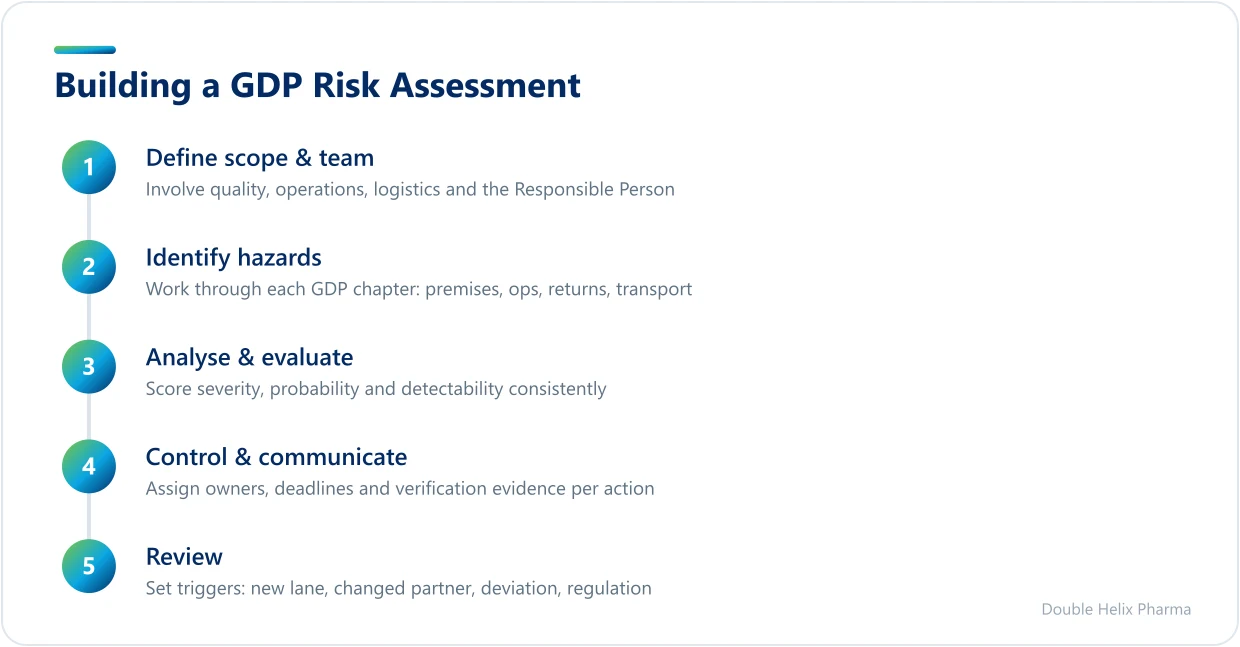
Method matters. Inspectors look for a repeatable, justified approach rather than a subjective list of worries. A workable structure follows the ICH Q9 lifecycle and stays deliberately practical.
- Define scope and assemble the right people. Involve quality, operations, logistics and the Responsible Person, because risk lives at the boundaries between functions.
- Identify hazards against the GDP chapters. Work systematically through premises, equipment, documentation, operations, complaints, returns, outsourced activities and transportation.
- Analyse and evaluate. Use a consistent scoring method for severity, probability and detectability. The chosen tool, whether a risk matrix or FMEA, matters less than applying it consistently.
- Control and communicate. Assign owners, deadlines and verification evidence to every action. An unowned risk is an uncontrolled risk.
- Review. Set triggers for reassessment, such as a new lane, a changed third party, a recurring deviation, or a regulatory update.
A risk register is only as good as the management review behind it. If risks are scored once and never revisited, the document protects nobody, least of all the patient.
Common pitfalls that weaken a GDP risk assessment
Several failure patterns appear repeatedly across MHRA inspections and internal audits.
- Generic, copied templates that describe a notional operation rather than your actual sites, lanes and products.
- Scores without rationale, where a "low" rating has no supporting logic an auditor can follow.
- Orphaned actions with no owner, no due date and no evidence of completion.
- Outsourcing blind spots, where transport and storage partners are assumed compliant without a technical or quality agreement and periodic oversight.
- Static documents that are never reopened between inspections, despite material changes to the business.
Each of these is straightforward to remedy once identified, and doing so usually sharpens operational decision-making as much as it satisfies the regulator.
Key takeaways
A strong GDP risk assessment is proportionate, evidence-led and alive. Concentrate effort where harm is most likely and most serious, typically temperature in transit and the integrity of your supplier and customer network, and apply ICH Q9 principles consistently so the logic survives challenge. Treat the register as a working tool with owners, deadlines and review triggers, not a static artefact produced for audit week.
If you would like an independent review of your distribution risk profile, our team of contract Responsible Persons and GDP auditors can help you focus on what matters and close the gaps that inspectors notice. Explore our full range of consultancy services or get in touch to discuss your supply chain.
Regulatory sources
This guidance reflects current UK and EU GMP/GDP requirements. Primary references:
- EMA — GMP/GDP Questions & Answers
- MHRA Inspectorate Blog
- MHRA — UK Medicines & Healthcare products Regulatory Agency
Always confirm against the latest published version of each source.
Frequently asked questions
How often should a GDP risk assessment be reviewed?+
There is no fixed regulatory interval, but the assessment should be reviewed whenever a material change occurs, such as a new distribution lane, a changed third-party provider, a recurring deviation or a regulatory update. Many organisations also schedule a periodic review at least annually as part of management review under ICH Q10. The key expectation is that the document is demonstrably current rather than left untouched between inspections.
Which risk assessment tool does the MHRA expect us to use?+
The MHRA does not mandate a specific tool. ICH Q9 supports a range of methods, from a simple risk matrix to FMEA, and the choice should suit the complexity of the activity. What inspectors look for is consistent application and a documented rationale behind each score, not a particular template.
Does a GDP risk assessment need to cover outsourced transport providers?+
Yes. The EU GDP guidelines hold the wholesale dealer responsible for product quality throughout the supply chain, including activities performed by contractors. Your assessment must therefore reach into the carrier's temperature controls, route handling and data integrity, supported by a technical or quality agreement and periodic oversight. Assuming a provider is compliant without evidence is a common inspection finding.