GDP Transport & Supply Chain · 7 min read
Handling Returns Under GDP
A senior QP's practical guide to GDP returns: quarantine, storage-condition evidence, cold-chain rules and the documented decisions MHRA inspectors expect.
By Balasubramanian Ramaiah · 9 June 2026 · Updated 18 August 2026
Returns are one of the highest-risk events in the pharmaceutical supply chain, and GDP returns are where good distribution practice is most often found wanting under inspection. Whether a product is coming back from a hospital, a pharmacy or a wholesaler, the decision to return it to saleable stock cannot be made on commercial grounds alone — it must be a documented, evidence-based judgement that protects patients from medicines whose quality can no longer be guaranteed. This article sets out a practical, defensible approach to handling returns under the EU GDP guidelines and the MHRA's expectations for UK wholesale dealers.
Why returns are a regulatory pressure point
Once a medicinal product has left your control, you lose direct oversight of how it was stored and transported. A pack that spent an afternoon on a car seat in summer, or a cold-chain item that drifted out of its 2–8°C window, looks identical to one that never left the warehouse. The whole purpose of the returns process is to close that visibility gap before the stock re-enters the supply chain.
The EU Guidelines on Good Distribution Practice (2013/C 343/01) are explicit: returned medicinal products may only be returned to saleable stock where a number of conditions are met and the decision is taken by an appropriately authorised, suitably trained person — in practice, with the oversight of the Responsible Person. This is a quality decision, not a logistics one, and inspectors will look for evidence that you treat it accordingly. It also intersects directly with falsified-medicines controls, since the returns channel is a known route for illegitimate product to attempt re-entry.
The core conditions for returning stock to saleable inventory
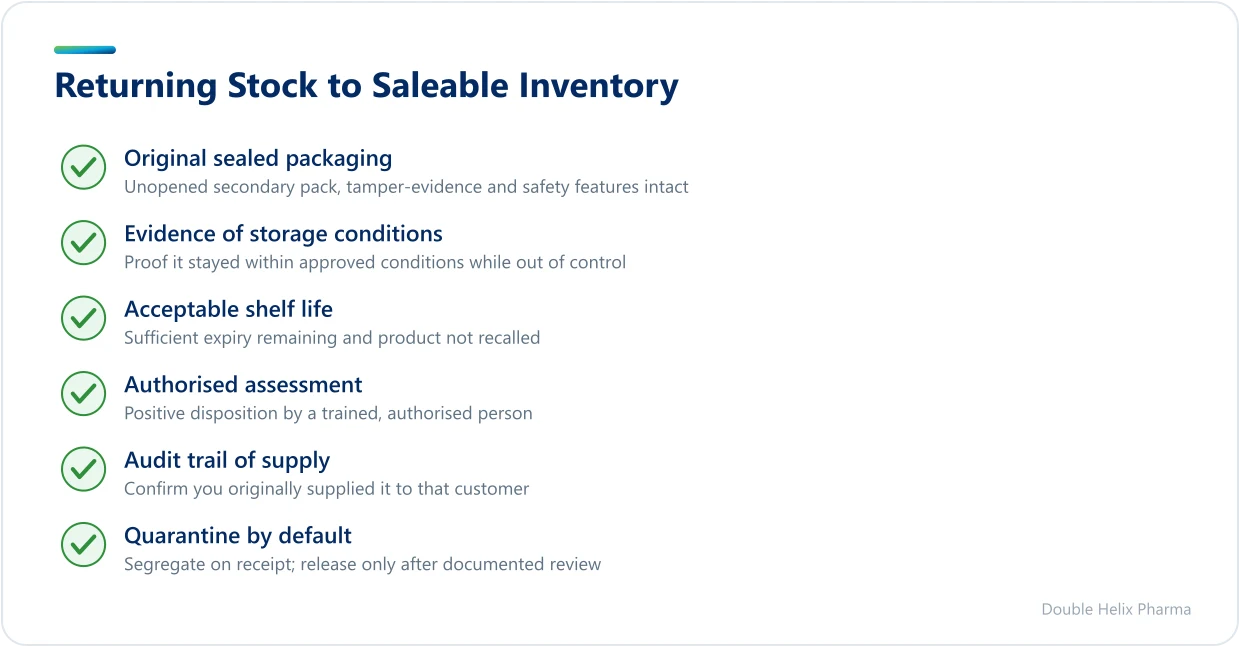
Under the GDP guidelines, the default position is that returned products should be quarantined on receipt and only released back to saleable stock once a documented assessment confirms they remain fit for sale. The conditions you must be able to evidence include the following.
- Original, sealed packaging. The medicines are in their original, unopened secondary packaging and in good condition, and any tamper-evidence and safety features remain intact.
- Demonstrated storage conditions. There is satisfactory evidence that the products were stored and handled within the approved conditions throughout the time they were out of your control. Without this assurance, the product cannot go back to saleable stock.
- Acceptable remaining shelf life. The remaining expiry period is sufficient and the product has not been recalled.
- Examination by an authorised person. The returned items have been assessed and a positive disposition recorded by a person trained and authorised to do so.
- Audit trail of supply. You can confirm the product was originally supplied by you to that customer, linking the return to your own legitimate distribution records.
For products requiring specific temperature control, the bar is higher still. If a refrigerated or otherwise temperature-sensitive product has been returned and there is no objective evidence — typically continuous temperature monitoring data — that it stayed within its labelled conditions, it should not be returned to saleable stock. Where doubt exists, the only defensible outcome is destruction.
Building a defensible GDP returns procedure
A robust returns procedure turns these principles into a repeatable, auditable workflow. At a minimum, your standard operating procedure should define each of the following stages.
Receipt and immediate quarantine
All returns should be received into a defined quarantine area or status — physically or within a validated computer system — and segregated from saleable stock so they cannot be picked in error. Record the returning customer, product details, batch number, quantity, expiry and the reason for return at the point of receipt.
Risk-based assessment and disposition
Apply the principles of ICH Q9 (Quality Risk Management): the level of scrutiny should be proportionate to the risk the product presents. A high-value cold-chain biologic returned without temperature data warrants a very different response from a sealed, ambient pack returned within hours under documented conditions. The authorised assessor reviews the evidence against your acceptance criteria and records a clear disposition — return to stock, or reject and destroy — with the rationale captured.
Documentation and traceability
Every return must be fully traceable. Records should follow ALCOA+ principles — attributable, legible, contemporaneous, original and accurate, plus complete, consistent, enduring and available. You should be able to reconstruct, for any returned batch, who handled it, what was decided, by whom and why. This documentation is also the backbone of effective recall and pharmacovigilance activity, and it is among the first things an inspector will ask to see.
Special cases: cold chain, controlled drugs and suspected falsified product
Some categories demand additional controls beyond the standard flow.
- Cold-chain and temperature-sensitive products. Treat the absence of continuous monitoring data as a fail. Excursion data should be assessed against the manufacturer's stability information before any disposition is made, and the Responsible Person should sign off on the criteria you apply.
- Controlled drugs. Returns of controlled drugs carry obligations under the Misuse of Drugs legislation in addition to GDP — including secure storage, accurate register entries and, where applicable, witnessed destruction by an authorised witness.
- Suspected falsified medicines. Any returned product suspected of being falsified must be segregated immediately, must not be returned to saleable stock, and must be reported to the competent authority and the marketing authorisation holder without delay. The returns area is a recognised vulnerability, so vigilance here is non-negotiable.
If there is any doubt about the quality of a returned medicinal product, it should not be considered suitable for re-issue or re-supply. The patient's safety, not the value of the stock, decides the outcome.
Common inspection findings and how to avoid them
In our GDP audit work we see the same returns deficiencies recur across very different operations. The most frequent include:
- Returns released back to saleable stock with no recorded assessment of storage conditions — particularly for ambient products wrongly assumed to be low risk.
- Quarantine that exists on paper but not in practice, with returned stock physically sitting alongside saleable inventory.
- Disposition decisions made by warehouse staff without documented training or delegated authority from the Responsible Person.
- Cold-chain returns accepted back without temperature data, on the strength of a customer's verbal assurance.
- Incomplete records that cannot link a return to the original outbound supply.
Each of these is straightforward to design out with a clear procedure, trained and authorised assessors, genuine physical or system segregation, and a quality management system — built on the principles of ICH Q10 — that makes returns a controlled process rather than an afterthought. Periodic self-inspection of your returns handling is the simplest way to catch drift before the regulator does. Our case studies illustrate how tightening these controls has helped distributors clear inspection findings and protect their wholesale dealer's licence.
Key takeaways
Handling GDP returns well comes down to a single principle: returned stock is guilty until proven innocent. It stays in quarantine until an authorised person, working to defined criteria and supported by real evidence of storage conditions, decides otherwise — and that decision, and its rationale, is always recorded.
- Quarantine on receipt; never return to saleable stock by default.
- Demand evidence of approved storage conditions, especially for cold-chain products.
- Make disposition a quality decision under Responsible Person oversight, documented to ALCOA+ standards.
- Segregate and report suspected falsified product immediately.
If you want a second pair of eyes on your returns procedure, or support from a contract Responsible Person, our GDP supply chain services are built around exactly these challenges — and you can explore our wider compliance services too. Contact our team to discuss a review of your returns handling before your next MHRA inspection.
Regulatory sources
This guidance reflects current UK and EU GMP/GDP requirements. Primary references:
- EMA — GMP/GDP Questions & Answers
- MHRA Inspectorate Blog
- MHRA — UK Medicines & Healthcare products Regulatory Agency
Always confirm against the latest published version of each source.
Frequently asked questions
Can a returned medicine always be put back into saleable stock under GDP?+
No. Under the EU GDP guidelines the default is quarantine, and stock may only be returned to saleable inventory when defined conditions are met. These include intact original packaging, satisfactory evidence of approved storage conditions, acceptable remaining shelf life and a documented assessment by an authorised person. If any doubt about quality remains, the product must not be re-issued.
What happens to cold-chain products returned without temperature data?+
Treat the absence of continuous monitoring data as a fail. Without objective evidence that a temperature-sensitive product stayed within its labelled storage conditions throughout the time it was out of your control, it should not be returned to saleable stock. Any recorded excursions should be assessed against the manufacturer's stability data before disposition, and where doubt persists the product should be destroyed.
Who is allowed to decide that a returned product can be resold?+
The disposition decision is a quality judgement, not a warehouse task. It must be made by a person who is specifically trained and authorised to do so, working under the oversight of the Responsible Person and against defined acceptance criteria. Inspectors expect to see documented training, delegated authority and a recorded rationale for each decision.