GDP Transport & Supply Chain · 7 min read
GDP Requirements for Couriers and 3PLs
A senior QP's guide to GDP courier requirements: temperature control, security, traceability, audits and quality agreements for couriers and 3PLs in transit.
By Balasubramanian Ramaiah · 9 June 2026 · Updated 4 July 2026
When a medicinal product leaves your warehouse, your responsibility for its quality does not stop at the loading bay. Understanding GDP courier requirements is now one of the most scrutinised areas of any MHRA inspection, because couriers and third-party logistics providers (3PLs) sit at the point where temperature excursions, theft, diversion and falsification are most likely to occur. This article sets out what good distribution practice expects from the transport leg of the supply chain, and how UK and EU quality teams should hold their logistics partners to account.
Why couriers and 3PLs fall squarely within GDP
The EU Guidelines on Good Distribution Practice of medicinal products for human use (2013/C 343/01) are explicit: transportation is an integral part of distribution, and the wholesale distribution authorisation holder remains accountable for the product throughout transit, even where the physical work is outsourced. A courier delivering ambient tablets and a global 3PL operating a cold-chain hub are subject to the same underlying principle — the quality of the product must be maintained from the point of dispatch to the point of receipt.
This matters because outsourcing transfers the activity, not the responsibility. Under Chapter 7 of the GDP guidelines, the contract giver (you) must assess the competence of the contract acceptor (the courier or 3PL) and verify that GDP obligations are understood and met. The MHRA expects to see that you have actively managed this relationship, not simply signed a carriage agreement and assumed compliance.
The core GDP courier requirements you must impose
Whether you move a few parcels a week or run pan-European lanes, the same expectations apply. Translate them into contractual obligations and verifiable controls rather than vague assurances.
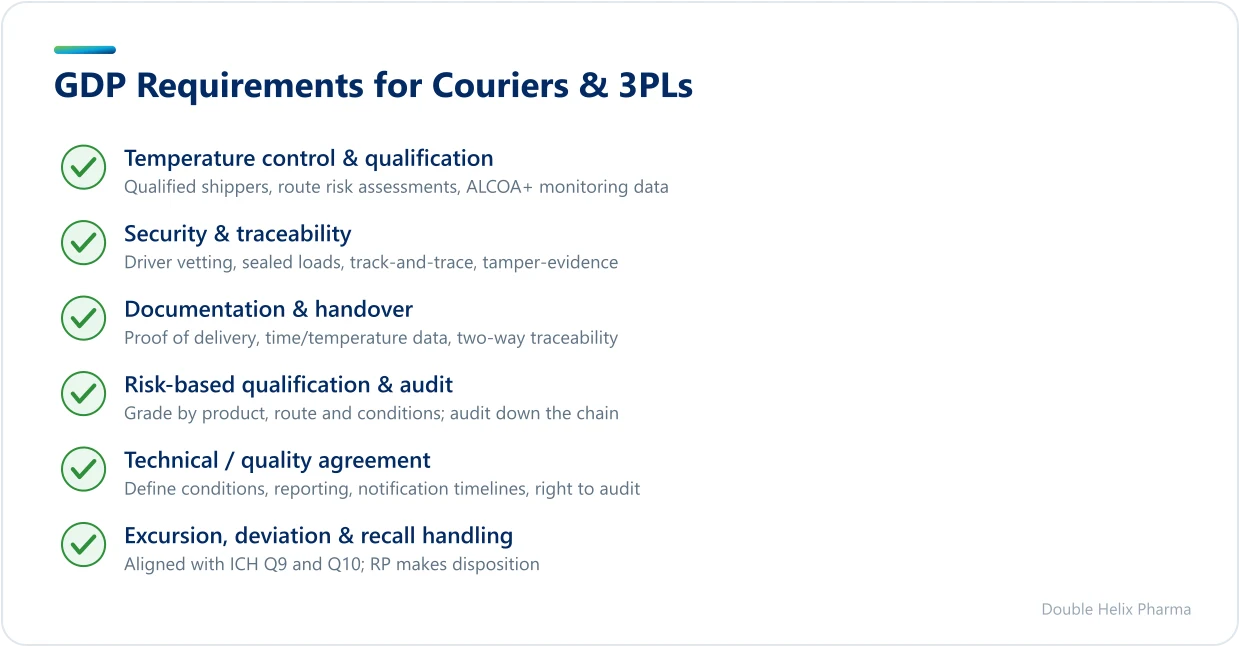
Temperature control and qualification
Vehicles, shippers and packaging must keep the product within its labelled storage conditions. This means qualified shipping solutions for cold-chain and, where ambient products are sensitive to extremes, route risk assessments covering seasonal and geographic variation. Temperature mapping of vehicles and refrigerated units should be available on request, and monitoring data must be ALCOA+ compliant — attributable, legible, contemporaneous, original and accurate — so that any excursion can be investigated and dispositioned by a responsible person.
Security, traceability and the falsified medicines threat
Transit is a high-risk window for theft and diversion. Couriers must demonstrate consignment security, driver vetting, sealed loads where appropriate, and the ability to track and trace shipments in near real time. Under the Falsified Medicines Directive, controls that prevent counterfeit product entering the supply chain do not pause during transport, so chain-of-custody documentation and tamper-evidence are essential.
Documentation and handover
Each delivery should be supported by records that allow the consignment to be traced in both directions. Proof of delivery, time and temperature data, and clear handover at the point of receipt all form part of the audit trail. Gaps here are among the most common findings cited against distributors.
Qualifying and auditing your logistics partners
Supplier qualification is where most courier and 3PL relationships succeed or fail. A risk-based approach, consistent with our GDP and supply chain expertise, should grade providers according to the products they carry, the routes involved and the storage conditions required. A courier handling controlled drugs or temperature-sensitive biologicals warrants far deeper scrutiny than one moving ambient stock over short distances.
- Initial assessment: confirm the provider understands GDP and, where it stores or breaks bulk, holds the appropriate wholesale dealer's authorisation (WDA(H)).
- On-site or remote audit: verify temperature controls, SOPs, training records, security and deviation management against the GDP guidelines.
- Ongoing oversight: review performance data, excursion trends and corrective actions at defined intervals, escalating where the risk profile changes.
For complex multimodal lanes, layered subcontracting is common, so your audit must follow the product down the chain rather than stopping at the prime contractor. We describe several of these engagements in our case studies.
Technical agreements: defining who does what
A robust technical or quality agreement is the backbone of GDP-compliant outsourcing. It should leave no ambiguity about responsibilities and is increasingly the first document an inspector asks to see. At a minimum it must address:
- The specific transport conditions and acceptable temperature ranges for each product or product group.
- Responsibilities for monitoring, recording and reporting temperature data and excursions.
- Notification timelines for deviations, delays, accidents, theft and suspected falsification.
- Handling of returns, recalls and quarantined product in transit.
- The right to audit, and the obligations on the provider to support recall and investigation activity.
An effective quality agreement does not merely allocate blame after an event; it defines the controls, data flows and decision rights that prevent the event in the first place.
Managing excursions, deviations and recalls in transit
Even well-controlled lanes generate excursions, and how you respond is a direct test of your quality system. Apply the principles of ICH Q9 (quality risk management) and ICH Q10 (pharmaceutical quality system): assess the impact on product quality using stability data, document the decision, and ensure a responsible person makes the disposition. A courier reporting a refrigeration failure six hours late has already compromised your ability to make a sound, science-based judgement, which is why notification timelines belong in the contract.
Transport also has to support rapid recall. If a product must be retrieved, your logistics partners need processes to locate, halt and return affected consignments quickly. The same discipline that underpins GMP-grade quality management — clear procedures, trained staff and verifiable records — should run through every link of distribution. Our wider consultancy services help quality teams build this end to end.
Key takeaways
Meeting GDP courier requirements is not about paperwork for its own sake; it is about protecting patients by keeping medicines within specification, secure and traceable until the moment of receipt. Outsourcing transport never outsources accountability, so qualify your couriers and 3PLs on a risk basis, underpin each relationship with a clear technical agreement, and audit far enough down the chain to see what is really happening to your product.
- Treat transport as a regulated activity governed by Chapter 7 of the GDP guidelines, not a commodity service.
- Demand qualified packaging, ALCOA+ temperature data and genuine traceability from every provider.
- Use quality agreements and risk-based audits to define and verify responsibilities.
- Build excursion, deviation and recall handling into your contracts, aligned with ICH Q9 and Q10.
If you would like an experienced QP and RP team to review your distribution network or qualify your logistics partners, get in touch with Double Helix Pharma UK for a practical, inspection-ready assessment.
Regulatory sources
This guidance reflects current UK and EU GMP/GDP requirements. Primary references:
- EMA — GMP/GDP Questions & Answers
- MHRA Inspectorate Blog
- MHRA — UK Medicines & Healthcare products Regulatory Agency
Always confirm against the latest published version of each source.
Frequently asked questions
Are couriers and 3PLs required to hold a wholesale dealer's authorisation (WDA(H))?+
A pure transport provider that only moves sealed consignments between sites generally does not need a WDA(H), as transportation itself is not wholesale dealing. However, if the courier or 3PL stores medicines, breaks bulk, or takes ownership and supplies onward, it is performing wholesale distribution and must hold the appropriate authorisation. Quality teams should confirm exactly which activities a provider performs before deciding what licensing and oversight apply.
Who is responsible if a temperature excursion happens during transit?+
Under the EU GDP guidelines, the wholesale distribution authorisation holder remains responsible for the product throughout transport, even when carriage is outsourced. The courier or 3PL is contractually accountable for maintaining the agreed conditions and reporting deviations, but the disposition decision rests with your responsible person. This is why a clear quality agreement defining monitoring, notification timelines and decision rights is essential.
How often should we audit our couriers and logistics providers?+
Audit frequency should be risk-based rather than fixed. Providers handling cold-chain, high-value or controlled products on complex routes typically warrant more frequent and deeper scrutiny than those moving ambient stock short distances. As a guide, an initial qualification audit followed by periodic re-audit, supported by ongoing review of excursion and performance data, allows you to escalate oversight whenever the risk profile changes.