QMS & PQS Implementation · 7 min read
Document Control Essentials for GMP
A practical guide to document control GMP: document hierarchy, lifecycle and change control, ALCOA+ data integrity and common pitfalls for UK and EU quality teams.
By Balasubramanian Ramaiah · 9 June 2026 · Updated 24 July 2026
Effective document control GMP is the connective tissue of a functioning pharmaceutical quality system. Without a controlled, version-managed, retrievable set of procedures and records, even the best-equipped site cannot demonstrate that it consistently does what its licence says it does. This article sets out the practical essentials UK and EU quality teams need to keep documentation defensible, inspection-ready and genuinely useful on the shop floor.
Why document control sits at the heart of GMP
EU GMP Chapter 4 makes the expectation explicit: a good documentation system is a fundamental part of the quality management system. Documents define how work should be performed; records prove how it was actually performed. When the two diverge, you have a data integrity problem, not merely an administrative one.
ICH Q10 frames the pharmaceutical quality system as the vehicle for control and continual improvement, and documentation is how that system becomes auditable rather than aspirational. Inspectors from the MHRA and other competent authorities routinely open an inspection by asking for the document hierarchy, the procedure for controlling procedures, and a recent change. If those three answers are slow or inconsistent, the tone of the inspection is set early.
The document hierarchy: from policy to record
A robust system is layered, and each layer has a defined owner and review cycle. Confusion between these tiers is a common root cause of audit findings, so it is worth being deliberate about structure.
- Policies and the Quality Manual — high-level intent and commitments, rarely changed.
- Standard operating procedures (SOPs) — how a process is performed, owned by the relevant function.
- Work instructions and protocols — granular, task-level detail for specific operations.
- Forms, templates and logbooks — the structures that capture data.
- Records — the completed evidence: batch records, logs, certificates and reports.
The discipline that holds the hierarchy together is traceability. A form should be uniquely identified and linked to its parent SOP; a batch record should reference the specifications and methods in force at the time of manufacture. Getting this architecture right early is far cheaper than retrofitting it, which is why it features so heavily in our QMS implementation work.
Lifecycle controls: creation, approval, change and retirement
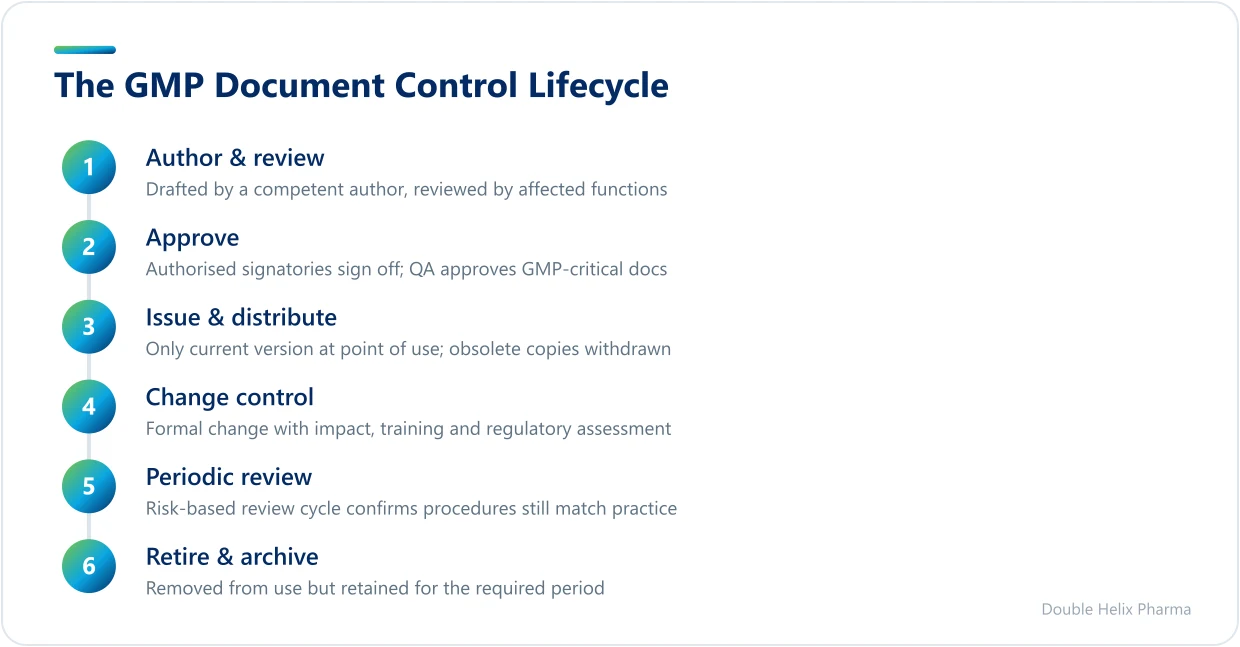
Every controlled document moves through a defined lifecycle, and each transition needs a control point. A mature system addresses the full span rather than focusing only on issue.
Authoring, review and approval
Documents should be drafted by someone competent in the process, reviewed by affected functions, and approved by authorised signatories — with Quality Assurance approving anything GMP-critical. Roles should be defined so that the author cannot be the sole approver of their own work.
Issue, versioning and distribution
Only the current, approved version should be available at the point of use. Effective dates, unique document numbers and clear version identifiers prevent the single most common shop-floor failure: working to a superseded procedure. Controlled-copy registers, or a validated electronic system, ensure obsolete versions are withdrawn promptly.
Change control and periodic review
Changes to documents should run through formal change control, with an assessment of impact, training and any regulatory consequences. Periodic review — typically on a defined cycle such as every two or three years, risk-adjusted — confirms that procedures still reflect reality. ICH Q9 principles let you focus review effort where the patient and product risk is greatest, rather than treating every form like a master batch record.
Retirement and archiving
Obsolete documents must be removed from use but retained for the required retention period. Retention schedules should reflect product lifecycle and legal requirements; for medicinal products this commonly extends well beyond the expiry of the last batch.
Good documentation practice and ALCOA+
Document control is inseparable from data integrity. The ALCOA+ principles — that records be Attributable, Legible, Contemporaneous, Original and Accurate, plus Complete, Consistent, Enduring and Available — are the yardstick MHRA inspectors apply to both paper and electronic systems.
If it is not documented, it did not happen — and if it cannot be reconstructed from the record, it cannot be defended.
In practice this means contemporaneous entries in indelible ink, single-line corrections that preserve the original entry, signed and dated changes, and a strict ban on back-dating, pencil, correction fluid or undocumented loose-leaf records. For electronic systems, the same expectations apply through validated software, secure user access, and audit trails that are reviewed rather than merely switched on. The MHRA's data integrity guidance and the principles behind Annex 11 and 21 CFR Part 11 all converge on the same point: the record must be trustworthy throughout its life.
Common pitfalls and pragmatic controls
Most documentation findings are avoidable. The recurring themes we see during audits include:
- Uncontrolled copies — printouts and local files circulating outside the system. Control distribution and date-stamp printed copies as uncontrolled where appropriate.
- Procedures that do not match practice — the gap between the SOP and the bench. Involve operators in authoring and revision.
- Weak change control — edits made without impact assessment or training. Tie every revision to a change record and a training action.
- Audit trails enabled but never reviewed — a frequent data integrity citation. Build periodic audit-trail review into routine batch release.
- Orphaned forms — templates with no parent procedure or owner. Maintain a master document list as the single source of truth.
A short, well-designed system that people actually follow beats an exhaustive one that they quietly work around. We have seen this play out repeatedly across our case studies, where simplifying and rationalising documentation improved both compliance and throughput.
Paper, hybrid or electronic?
An electronic document management system brings clear advantages — enforced workflows, version control, automatic withdrawal of obsolete versions and reliable audit trails. But the system must be validated, access-controlled and supported by procedures, or it simply digitises existing weaknesses. Hybrid systems, where a printed record is signed against an electronic master, demand particular care to define which version is the official record. Whichever model you operate, the governing principles of GMP documentation do not change; the technology only changes how you enforce them. The same rigour underpins the wider range of quality and compliance support we provide across our services.
Key takeaways
Strong document control GMP is not bureaucracy for its own sake; it is the mechanism by which a quality system becomes provable. Keep the hierarchy clean, control the full document lifecycle, hold every record to ALCOA+, and review audit trails as a matter of routine. Above all, design documentation that the people doing the work can actually follow.
If you are building a quality system from scratch, remediating inspection findings, or preparing a site for an MHRA or competent-authority inspection, our Qualified Persons can help you get the foundations right. Contact our team to discuss a practical, risk-based document control framework for your site.
Regulatory sources
This guidance reflects current UK and EU GMP/GDP requirements. Primary references:
- EU GMP Chapter 1 — Pharmaceutical Quality System
- EudraLex Volume 4 — EU GMP Guidelines
- EMA — GMP/GDP Questions & Answers
Always confirm against the latest published version of each source.
Frequently asked questions
What does EU GMP Chapter 4 require for document control?+
EU GMP Chapter 4 treats good documentation as a fundamental part of the quality management system, distinguishing between instructions (procedures, specifications, protocols) and records (the completed evidence of work performed). It expects documents to be approved, signed and dated by authorised persons, available at the point of use, and retained for defined periods. The aim is a system in which any activity can be reconstructed and defended from the records alone.
How do ALCOA+ principles apply to GMP documentation?+
ALCOA+ means every record should be Attributable, Legible, Contemporaneous, Original and Accurate, plus Complete, Consistent, Enduring and Available. In practice this drives contemporaneous entries, single-line corrections that preserve the original, signed and dated changes, and a ban on back-dating or correction fluid. For electronic systems the same expectations are met through validated software, controlled user access and audit trails that are actively reviewed.
How often should SOPs be reviewed under GMP?+
There is no single mandated frequency, but a periodic review cycle of roughly every two to three years is common, adjusted according to risk using ICH Q9 principles. Critical, high-risk procedures may warrant more frequent review, while stable low-risk forms can be reviewed less often. Any change in process, equipment, regulation or following a deviation should also trigger an out-of-cycle review through formal change control.