GDP Transport & Supply Chain · 7 min read
Direct-to-Patient and Last-Mile Distribution
Direct to patient distribution moves medicines to the doorstep. Here is how UK and EU quality teams keep the last mile GDP-compliant, secure and inspection-ready.
By Balasubramanian Ramaiah · 9 June 2026 · Updated 18 September 2026
Direct to patient distribution is reshaping how medicines move from the licensed supply chain to the people who need them, whether that means a specials order delivered to a hospital outpatient, a clinical trial kit shipped to a participant's home, or a cold-chain biologic handed over at a kitchen door. For UK and EU quality teams, the appeal is obvious; the regulatory exposure, less so. The discipline that holds it all together is good distribution practice applied with the same rigour at the last mile as in the warehouse.
Why direct to patient distribution changes the risk picture
Traditional GDP assumes hand-offs between licensed, audited entities: manufacturer to wholesaler, wholesaler to pharmacy or hospital. The product stays within a closed network of organisations that hold Wholesale Dealer's Authorisations (WDA(H)) and operate to the MHRA-enforced EU Guidelines on Good Distribution Practice of Medicinal Products (2013/C 343/01). Direct-to-patient models stretch that network to its limit. The final recipient is not a regulated party, the delivery environment is uncontrolled, and the courier may have no pharmaceutical training whatsoever.
That shift does not remove your obligations; it concentrates them. The marketing authorisation holder, the WDA holder and the Responsible Person remain accountable for product quality and traceability right up to the point of receipt. Applying ICH Q9 quality risk management to the last mile is therefore not optional. You are expected to identify where temperature, security, identity and documentation controls could fail, and to put proportionate mitigations in place before the first parcel leaves the dock.
Temperature control at the last mile
Last-mile transport is where cold-chain integrity most often unravels. A validated 2–8°C lane between two distribution centres tells you little about a four-hour van round in summer, multiple door openings, and a parcel left in a porch. Annex 15 expects qualification of transport routes and equipment; the GDP guidelines expect you to maintain conditions throughout.
Qualifying packaging and routes
Qualified shipping containers should be selected against the worst-case ambient profile for the season and geography, not an annual average. Where you rely on passive packaging, document the validated hold time and build in a safety margin for predictable delays. For ambient products, remember that "room temperature" labelling still carries an upper limit; a sealed vehicle in July can breach it within the hour.
Monitoring and excursion management
Continuous temperature monitoring with calibrated data loggers, reviewed against pre-agreed alarm limits, gives you the evidence base the MHRA will ask for. Define excursion handling before go-live: who assesses the deviation, against what stability data, and within what timeframe a quarantine-or-release decision is made. A patient waiting at home is not a reason to short-circuit that assessment.
Security, identity and the falsified medicines problem
Once a medicine leaves the regulated network it becomes harder to protect and easier to divert. The Falsified Medicines Directive framework was built around decommissioning at the point of dispensing, so direct-to-patient flows must be designed so that serialisation and pack verification happen at the correct, authorised step rather than being skipped because the route is unusual.
- Chain of custody: every transfer should be recorded, with the recipient's identity confirmed at delivery for prescription-only medicines.
- Tamper evidence: outer packaging and anti-tampering devices must remain intact and be checked on receipt.
- Diversion controls: couriers and routes should be risk-assessed for theft, and high-value or controlled drugs handled under enhanced security with the relevant Home Office requirements observed.
Document everything to ALCOA+ standards. If a delivery record is not attributable, legible, contemporaneous, original and accurate, you cannot demonstrate that the product reached the right patient in the right condition, and you cannot defend the batch in an inspection.
Roles, responsibilities and technical agreements
Most direct-to-patient operations involve several parties: the MA holder, a logistics provider, possibly a homecare company, and sometimes a separate clinical trial sponsor. Under the GDP guidelines, the Responsible Person of the WDA holder retains oversight of the distribution activity even when execution is outsourced. That oversight has to be real, evidenced through audit and performance review, not a name on a certificate.
Written technical and quality agreements should make the boundaries unambiguous: who qualifies packaging, who monitors temperature, who manages deviations, who handles returns and recalls, and how data flows between parties. The contractor's ICH Q10 pharmaceutical quality system should be assessed before appointment and monitored thereafter. Recall capability deserves particular attention, because retrieving product from individual patients is materially harder than recovering pallets from a depot, and your procedure must reflect that.
Building a compliant direct to patient distribution model
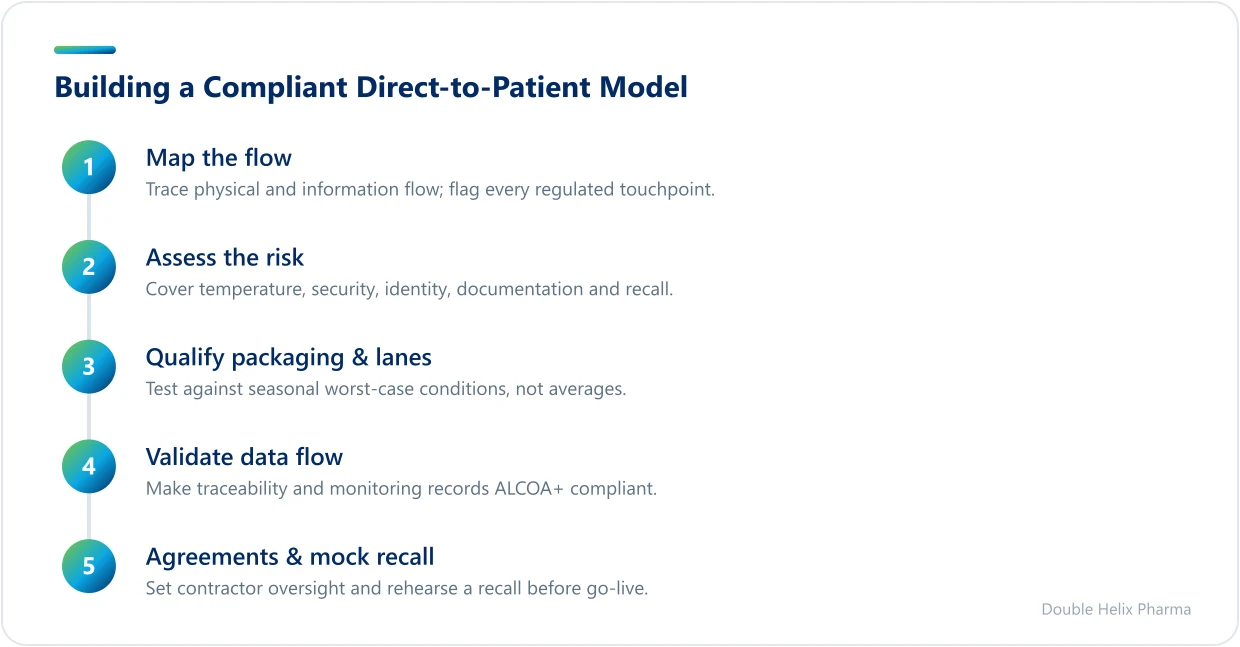
A defensible model is built deliberately, in a sequence that lets risk drive the design rather than retrofitting controls after launch.
- Map the full physical and information flow, end to end, and identify every regulated and non-regulated touchpoint.
- Run a structured risk assessment covering temperature, security, identity, documentation and recall.
- Qualify packaging and transport lanes against seasonal worst-case conditions.
- Define and validate the data flow so that traceability and monitoring records are complete and ALCOA+ compliant.
- Put technical agreements and contractor oversight in place, and rehearse a mock recall before going live.
This is the same logic we apply across our GDP supply chain support, and it scales from a single homecare line to a multi-country distribution network. Several of our case studies describe how route qualification and contractor oversight were brought up to inspection standard without stalling supply.
Key takeaways
Direct to patient distribution can be done compliantly, but only when last-mile risk is engineered out rather than tolerated. Treat the patient's doorstep as the final node of a validated, monitored, fully documented supply chain, and hold your logistics partners to the same GDP expectations you would apply inside your own warehouse.
- Apply ICH Q9 risk management specifically to the last mile, not just the trunk route.
- Qualify packaging and lanes against seasonal worst-case conditions and monitor continuously.
- Protect identity, security and serialisation once product leaves the regulated network.
- Keep RP oversight real and back every step with ALCOA+ records.
If you are designing or scaling a direct-to-patient or homecare model and want it built to withstand MHRA scrutiny, contact our team to discuss a risk assessment and route qualification, or explore the full range of our services.
Regulatory sources
This guidance reflects current UK and EU GMP/GDP requirements. Primary references:
- EMA — GMP/GDP Questions & Answers
- MHRA Inspectorate Blog
- MHRA — UK Medicines & Healthcare products Regulatory Agency
Always confirm against the latest published version of each source.
Frequently asked questions
What is direct to patient distribution in a GDP context?+
It is the delivery of medicinal products from the licensed supply chain directly to the patient, bypassing the traditional pharmacy or hospital hand-off. Examples include homecare medicines, specials and clinical trial kits shipped to a participant's address. Although the final recipient is unregulated, the marketing authorisation holder and Wholesale Dealer's Authorisation holder remain accountable for product quality and traceability up to the point of receipt.
Does the Responsible Person still have oversight when delivery is outsourced?+
Yes. Under the EU Guidelines on Good Distribution Practice, the Responsible Person of the WDA holder retains oversight of distribution even when a logistics or homecare provider carries it out. That oversight must be evidenced through written technical agreements, contractor qualification and ongoing performance review, not just a signed contract. Recall capability and deviation handling should be explicitly assigned and rehearsed.
How should temperature excursions during last-mile delivery be handled?+
Excursion limits should be defined before go-live using the product's stability data, with continuous monitoring via calibrated data loggers. When an alarm is triggered, a named, competent person assesses the deviation against agreed criteria and makes a documented quarantine-or-release decision. A patient waiting at home is never a justification for skipping that assessment, and all records must meet ALCOA+ standards.