Contract QP, RP & RPi · 7 min read
The RP Gold Standard: What the MHRA Expects
The RP gold standard explained: what the MHRA truly expects of a Responsible Person on a UK WDA(H), from product knowledge to data integrity.
By Balasubramanian Ramaiah · 9 June 2026 · Updated 7 August 2026
For a UK Wholesale Dealer's Authorisation (WDA(H)) holder, the named Responsible Person is the difference between a routine inspection and a critical observation. The RP gold standard is not about having a name on a licence; it is about demonstrable control, current product knowledge and the personal authority to stop the supply chain when something is wrong. This article sets out, plainly, what the MHRA expects of an RP who is genuinely meeting that bar.
What "Responsible Person" actually means under UK GDP
The Responsible Person (RP) is a statutory role under the Human Medicines Regulations 2012 and is the legal anchor for compliance with EU Guidelines on Good Distribution Practice (2013/C 343/01), which the MHRA continues to apply post-Brexit. A second variant, the RP for import (RPi), applies where a WDA holder introduces medicines into Great Britain from an EEA country and must confirm appropriate oversight before those products are placed on the market.
The RP is named on the WDA(H) and is accountable to the MHRA for the quality system governing receipt, storage, distribution and supply of medicinal products. Crucially, the role cannot be reduced to a signature. Inspectors expect the RP to be a real, contactable, competent individual who exercises judgement, not a job title borrowed for the application.
RP versus RPi: a frequent point of confusion
Many sites conflate the two. The RP governs general GDP compliance for the licence; the RPi specifically assures that medicines imported from the EEA have been certified by a Qualified Person in the exporting country, or that equivalent control exists. If your business model involves importation, you need clarity on which role covers what, documented in writing.
The RP gold standard: nine duties the MHRA actually inspects
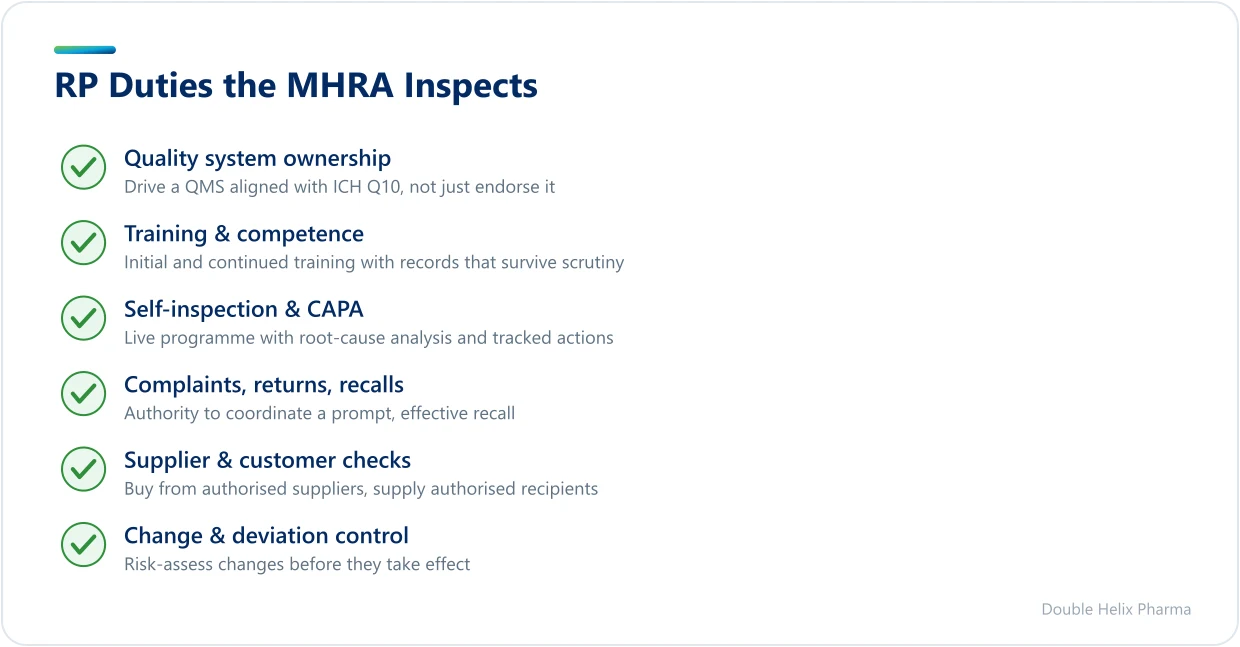
The GDP guidelines list specific responsibilities, but the gold standard is how an RP evidences them day to day. In practice, inspectors probe:
- Quality system ownership — implementing and maintaining a QMS aligned with the principles of ICH Q10, with the RP visibly driving it rather than merely endorsing it.
- Training and competence — ensuring initial and continued training of all personnel involved in distribution, with records that survive scrutiny.
- Self-inspection — a live programme with documented findings, root-cause analysis and tracked corrective actions, not an annual box-tick.
- Complaints, returns and recalls — approving procedures and demonstrating the authority to coordinate a recall promptly and effectively.
- Supplier and customer qualification — verifying that you buy only from authorised suppliers and supply only to authorised recipients.
- Falsified medicines — operating controls under the safety features framework and decommissioning obligations where they apply.
- Returns to saleable stock — approving the conditions under which returned products may re-enter the supply chain.
- Change control and deviation management — ensuring changes are risk-assessed before, not after, they take effect.
- Delegation with retained accountability — the RP may delegate tasks but never the responsibility itself.
The common thread is evidence. An RP who can describe a control but cannot produce the record behind it has, in inspection terms, not met the standard.
Knowledge, presence and independence: the three tests
When the MHRA assesses whether an RP is fit for purpose, three qualities separate a nominal appointment from a credible one.
Current product and regulatory knowledge
The RP must understand the specific product categories handled — cold-chain biologics, controlled drugs, unlicensed specials or parallel-imported lines each carry different obligations. Generic GDP awareness is insufficient. An RP for a cold-chain operation, for example, must grasp temperature-mapping data, qualification of storage areas and the realities of validated transport, with the same rigour an Annex 1 environment demands of contamination control.
Genuine presence and contactability
Inspectors increasingly challenge "absentee" RPs. The role requires sufficient time and authority at the site to discharge the duties. A contract RP covering several clients can absolutely meet the gold standard, but only with a defined time commitment, documented site visits and immediate reachability when issues arise.
Independence and authority to act
The RP must be able to halt distribution of a suspect batch even when commercial pressure pushes the other way. That authority should be written into the quality agreement and the organisational structure, so it is never a matter of personality or negotiation in the moment.
Data integrity: where good distribution stands or falls
Distribution records are data, and the MHRA applies the same ALCOA+ expectations to a wholesaler's batch traceability and temperature logs as it does to a manufacturer's batch records. Attributable, Legible, Contemporaneous, Original and Accurate — plus Complete, Consistent, Enduring and Available — is the benchmark.
Echoing the spirit of 21 CFR 211 and EU GMP, a credible RP treats audit trails, temperature monitoring and supplier verification records as primary evidence. The frequent failures are mundane: gaps in temperature logs, uncontrolled spreadsheets, and "to follow" signatures. ICH Q9 quality risk management should drive where you focus monitoring effort, so that the highest-risk products and processes receive the most rigorous oversight.
If a record cannot be reconstructed under questioning, the activity it describes is, for inspection purposes, treated as not having happened.
Building an RP function that survives inspection
Whether you appoint internally or engage a contract RP, the gold standard is achievable with a deliberate structure. Practical steps that consistently hold up:
- Document the RP's duties, authority and minimum time commitment in a signed role description and, for contract arrangements, a clear quality agreement.
- Run a meaningful self-inspection programme and keep the CAPA log demonstrably current.
- Maintain a living training matrix mapped to actual job functions.
- Qualify suppliers and customers before transacting, and re-verify on a risk basis.
- Test your recall process periodically, rather than assuming it works.
For organisations without a suitable individual in post, our contract QP, RP and RPi services place an experienced, MHRA-credible named person on your licence with a defined scope and genuine presence. You can review how this works in practice through our case studies, or see the wider picture across our full range of quality and compliance services.
Key takeaways
The RP gold standard is ultimately about substance over title: current product knowledge, real presence, documented authority and data you can defend. Inspectors are no longer satisfied by a name on a WDA(H); they want to meet a competent professional who owns the quality system and will stop the supply chain when patient safety demands it.
If you are preparing for inspection, transitioning licences, or simply unsure whether your current arrangement would withstand scrutiny, talk to our team for a frank, practitioner-led assessment of your RP function.
Regulatory sources
This guidance reflects current UK and EU GMP/GDP requirements. Primary references:
- EU GMP Annex 16 — Certification by a Qualified Person and Batch Release
- EMA — GMP/GDP Questions & Answers
- EudraLex Volume 4 — EU GMP Guidelines
Always confirm against the latest published version of each source.
Frequently asked questions
What is the difference between an RP and an RPi?+
The Responsible Person (RP) is named on a UK Wholesale Dealer's Authorisation and is accountable for general Good Distribution Practice compliance across receipt, storage and supply. The RP for import (RPi) is a distinct role required when medicines are introduced into Great Britain from an EEA country, and specifically assures that those products were certified by a Qualified Person in the exporting state or are subject to equivalent control. A single individual may hold both, but the scope of each should be documented separately.
Can a contract RP meet the MHRA's expectations for a site?+
Yes. A contract RP can fully meet the gold standard provided the arrangement specifies a genuine time commitment, documented site presence and immediate contactability. The MHRA's concern is with absentee or nominal appointments, not with outsourcing itself. A clear quality agreement defining duties, authority and the right to halt distribution is essential to demonstrate the role is real.
How does data integrity apply to wholesale distribution?+
The MHRA applies ALCOA+ principles to distribution records just as it does to manufacturing. Temperature logs, batch traceability and supplier verification records must be attributable, legible, contemporaneous, original and accurate, as well as complete and enduring. Uncontrolled spreadsheets, gaps in temperature monitoring and retrospective signatures are among the most common findings, and a credible RP treats these records as primary inspection evidence.