GMP & GDP Audits · 7 min read
Remote vs On-Site GMP Audits: When to Use Each
A QP-grade guide to choosing between a remote GMP audit and on-site inspection, with a risk-based framework for when to use each and when to blend both.
By Balasubramanian Ramaiah · 9 June 2026 · Updated 22 September 2026
Choosing between a remote GMP audit and a traditional on-site inspection is now a routine decision for UK and EU quality teams, not an emergency workaround. The pandemic normalised distant assessment, but the harder question is when each approach genuinely satisfies your risk profile and regulatory expectations. This article sets out a practical, QP-grade framework for deciding which to use, when to blend them, and how to keep either approach defensible under MHRA and EU GMP scrutiny.
What changed, and what the regulators actually expect
Distant assessment moved from improvisation to a recognised tool during 2020-2021, and supervisory authorities have since clarified that it is a risk-based option rather than a permanent substitute for physical presence. The EU GMP framework, MHRA guidance and the underlying principles of ICH Q9 (Quality Risk Management) and ICH Q10 (Pharmaceutical Quality System) all point in the same direction: the depth and method of an audit should be proportionate to the risk the activity poses to product quality and patient safety.
Crucially, no major framework treats a remote audit as automatically equivalent to an on-site one. The expectation is that you justify your choice, document the rationale, and recognise the inherent limitations of assessing a facility you have not physically walked. That justification is itself an auditable record.
When a remote GMP audit is the right call
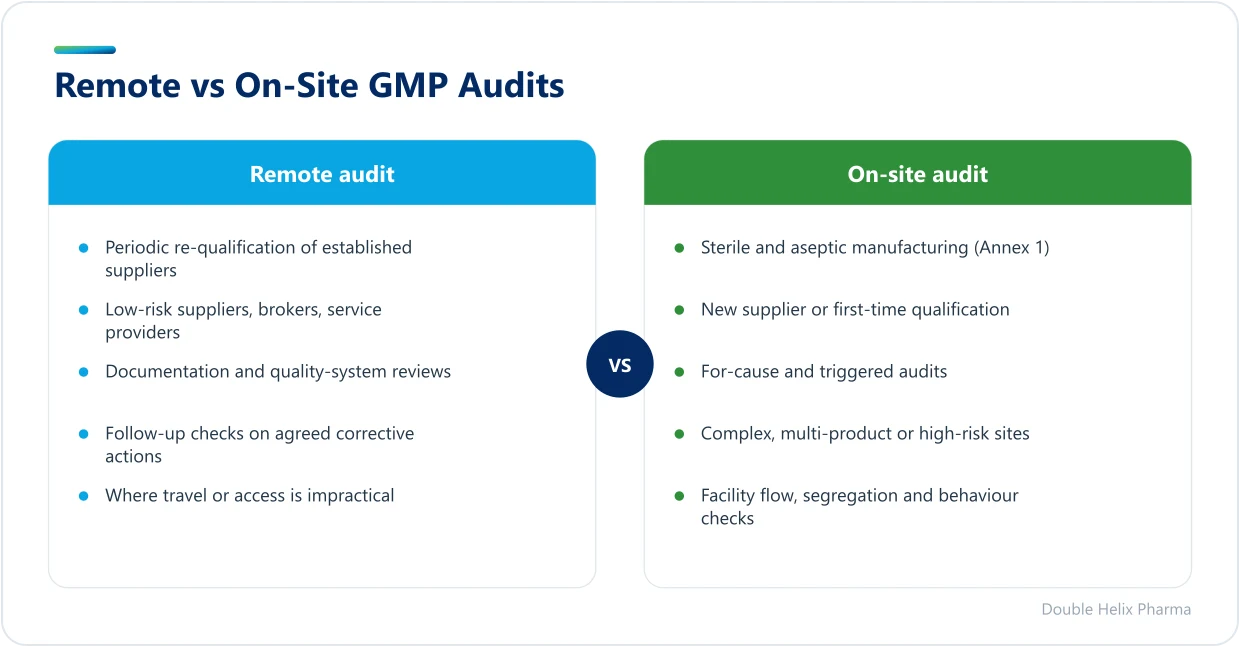
A remote GMP audit works well where the principal evidence is documentary, the supplier relationship is mature, and the risk is well understood. Typical scenarios include:
- Periodic re-qualification of an established supplier with a strong audit history and no recent significant findings.
- Low-risk activities such as certain excipient suppliers, brokers, or service providers where physical processing is limited.
- Documentation-heavy reviews of quality systems, batch records, deviation and CAPA management, change control, and training records.
- Follow-up verification of corrective actions agreed at a previous on-site audit, where you are checking evidence rather than re-assessing the whole operation.
- Geographic or access constraints, where travel is impractical and delaying assessment would create a greater compliance gap than auditing remotely.
Done properly, remote auditing can also be more frequent and less disruptive, allowing you to maintain oversight of a wider supplier base. It supports the supplier management discipline that sits at the heart of a healthy quality and compliance programme.
Making remote evidence trustworthy
The recurring weakness of distant assessment is data integrity. You cannot personally verify that what you are shown on screen is complete, contemporaneous and unaltered. Apply ALCOA+ thinking rigorously: request records in their native format where possible, ask to see audit trails live, and use unannounced screen-shares of systems rather than pre-prepared extracts. Where a live facility walk-through is offered by video, treat it as supportive context, not as a substitute for a physical line inspection.
When only an on-site audit will do
Physical presence remains essential where the audit objective depends on direct observation of people, environment and behaviour. Reserve on-site assessment for:
- Sterile and aseptic manufacturing, where Annex 1 expectations around contamination control strategy, gowning, environmental monitoring and operator technique cannot be judged credibly through a screen.
- New supplier qualification or first-time approval, where you have no prior relationship or audit history to lean on.
- For-cause and triggered audits following serious deviations, recalls, complaints or data integrity concerns.
- Complex operations such as multi-product facilities, sterile fill-finish, ATMPs, or sites with significant cross-contamination risk.
- Facility, flow and segregation checks, where personnel and material movement, line clearance and equipment status must be seen in context.
On-site work also surfaces the intangibles: the state of housekeeping, the candour of operators, the body language in the room when a difficult question is asked. These cues frequently flag issues long before they appear in a document, and they are largely invisible remotely.
The hybrid model: combining both approaches
In practice, the strongest assurance often comes from sequencing the two methods rather than choosing one outright. A hybrid programme might use a remote review to examine the quality system and documentation in advance, then concentrate a shorter on-site visit on the shop floor, sterile areas and direct observation. This focuses scarce auditor time where physical presence adds the most value.
Hybrid approaches are particularly effective for routine GMP and GDP oversight across a distributed supplier network, and for importer quality teams managing third-country manufacturing sites. They also align neatly with a risk-based audit schedule, letting you escalate from remote to on-site whenever findings, complaints or product criticality warrant it. Our case studies illustrate how a blended cadence can sustain oversight without overwhelming a lean quality function.
A risk-based decision framework
Rather than defaulting to habit, run each audit through a short, documented decision process grounded in ICH Q9:
- Define the objective. Re-qualification, for-cause, new approval or follow-up? The purpose drives the method.
- Score the risk. Consider product criticality (sterile versus solid dose), patient impact, process complexity and supply chain position.
- Weigh the history. A long, clean record with a responsive supplier supports remote work; a thin or troubled history pushes towards on-site.
- Assess data integrity exposure. Where systems, audit trails and electronic records carry the most risk, plan how you will verify them credibly.
- Document the rationale. Record why you chose the method, what its limitations are, and what would trigger a switch to on-site. This is your defence in an MHRA inspection.
Applied consistently, this framework keeps your audit programme proportionate and inspection-ready. It is the same logic we build into client GMP audit programmes, ensuring every assessment method is justified, recorded and aligned to risk.
Key takeaways
A remote GMP audit is a legitimate, regulator-recognised tool, not a shortcut, when it is matched to the right risk. Use it for periodic re-qualification, low-risk suppliers and documentation review; reserve on-site work for sterile manufacturing, new suppliers, for-cause investigations and anything where direct observation is decisive. Most mature programmes land on a hybrid model, escalating between methods as risk dictates and documenting the rationale every time.
The method is a means to assurance, not the assurance itself. Whatever you choose, the question an inspector will ask is simple: can you justify it, and can you prove it?
If you would like an experienced QP to review your audit strategy, build a risk-based schedule, or conduct remote, on-site or hybrid GMP audits on your behalf, get in touch with our team to discuss your requirements.
Regulatory sources
This guidance reflects current UK and EU GMP/GDP requirements. Primary references:
- EudraLex Volume 4 — EU GMP Guidelines
- EU GMP Chapter 9 — Self Inspection
- MHRA Inspectorate Blog
- EMA — GMP/GDP Questions & Answers
Always confirm against the latest published version of each source.
Frequently asked questions
Are remote GMP audits accepted by the MHRA and EU regulators?+
Yes, distant assessment is recognised as a legitimate, risk-based option rather than an automatic equivalent to an on-site inspection. Regulators expect you to justify and document why a remote approach is appropriate for the specific risk, and to acknowledge its limitations. The choice itself becomes an auditable record under your ICH Q9 quality risk management process.
When should I insist on an on-site GMP audit instead of a remote one?+
Reserve on-site audits for situations where direct observation is decisive: sterile and aseptic manufacturing under Annex 1, first-time qualification of a new supplier, and for-cause audits triggered by serious deviations, recalls or data integrity concerns. Physical presence lets you assess personnel and material flow, line clearance, housekeeping and operator behaviour that simply cannot be judged credibly through a screen.
How do I protect data integrity during a remote GMP audit?+
Apply ALCOA+ principles rigorously throughout the assessment. Request records in their native electronic format, ask to view audit trails live during unannounced screen-shares, and avoid relying solely on pre-prepared extracts that could be incomplete or altered. Treat any video facility tour as supporting context rather than a substitute for a physical inspection of the line.