GMP & GDP Audits · 7 min read
Closing Out Audit Findings: A CAPA Playbook
A practical audit CAPA playbook for UK and EU pharma: classify findings by risk, do defensible root cause analysis, and close out with effectiveness checks.
By Balasubramanian Ramaiah · 9 June 2026 · Updated 6 August 2026
Receiving the audit report is the easy part. The real test of a quality system is what happens next: whether your audit CAPA process turns findings into durable, evidence-backed change, or simply files them away until the same observation reappears at the next inspection. Closing out findings well is a discipline in its own right, and it is one the MHRA and EU inspectorates scrutinise closely.
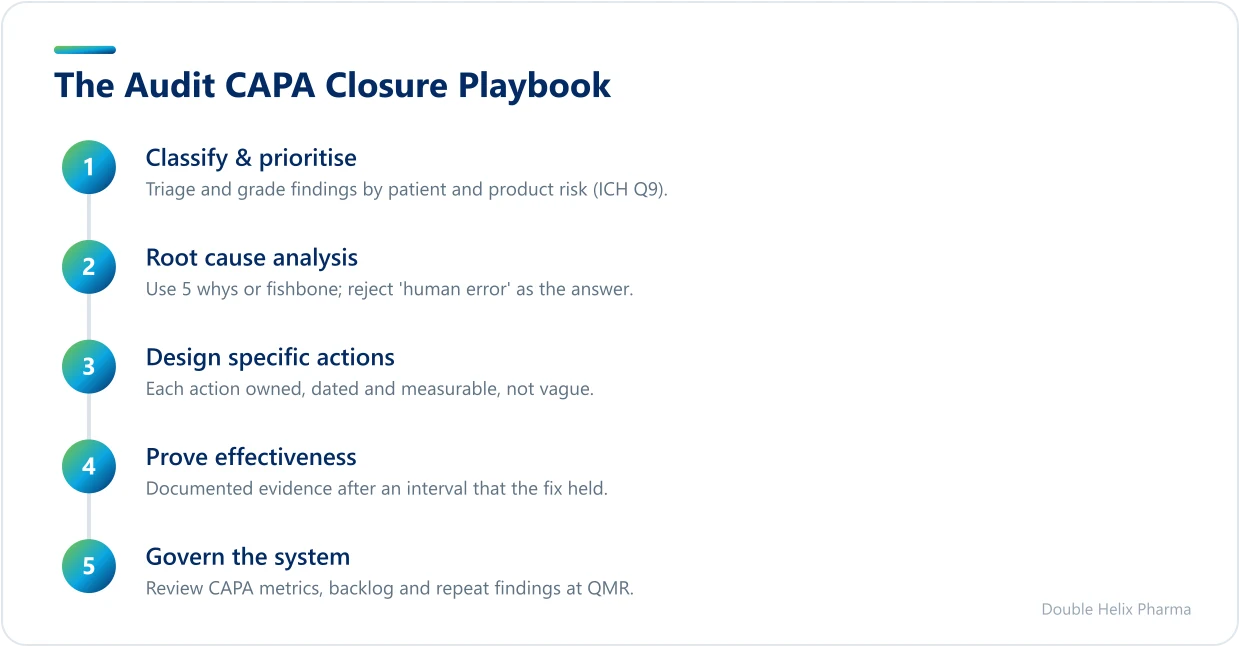
This playbook sets out a practical, risk-based approach to corrective and preventive action that holds up under EU GMP, MHRA expectations and the ICH Q9 and Q10 framework, whether the findings come from a regulator, a client audit, an internal self-inspection or a supplier qualification.
What good audit CAPA actually means
The single most common mistake is confusing a correction with a corrective action. Replacing a torn cleanroom gown, re-training the operator who made the error, or re-issuing a single batch record corrects the immediate problem. It does nothing to stop recurrence. A genuine audit CAPA programme separates three distinct activities and documents each one:
- Correction — the immediate remediation of the specific instance found.
- Corrective action — eliminating the root cause so that this finding cannot recur.
- Preventive action — addressing the same vulnerability wherever else it could plausibly arise across the site or quality system.
ICH Q10 places CAPA at the heart of the pharmaceutical quality system, and ICH Q9 expects the effort you invest to be proportionate to risk. A minor documentation observation does not warrant the same machinery as a data integrity failure or an Annex 1 contamination control gap. Grading findings honestly — critical, major, minor — is therefore the first step, not an afterthought.
Step one: classify and prioritise the findings
Before any action is assigned, triage the full list of observations. Group them by theme rather than tackling them in the order they appear in the report, because clusters usually share a root cause. A batch-record gap, an uncontrolled spreadsheet and a disabled audit trail are three findings but often one systemic data-governance weakness.
Apply risk, not just severity
Use quality risk management principles from ICH Q9 to rank what gets attention first. Patient safety and product quality come ahead of administrative tidiness. A critical finding affecting sterility assurance, ALCOA+ data integrity or release decisions demands immediate containment and an interim control while the permanent fix is developed. Document that interim measure: inspectors want to see the gap was contained on day one, not in ninety days.
Step two: root cause analysis that withstands challenge
Weak root cause analysis is itself one of the most frequently cited findings. Stopping at "operator error" or "human error" is rarely defensible; it describes the symptom, not why the system allowed the error to occur. A structured method — five whys for straightforward cases, or fishbone and fault-tree analysis for complex multi-factor events — forces the investigation past the first plausible answer.
If your corrective action is "re-train the operator" and nothing about the procedure, layout, system or workload changes, you have not found the root cause. You have found someone to blame.
Test every proposed root cause with a simple question: if we eliminate this, will the finding genuinely be prevented? Where the honest answer is no, the analysis is incomplete. For recurring deviations, examine whether a previous CAPA failed and why — a repeat finding is a red flag that the original investigation was superficial.
Step three: design actions that are specific and verifiable
Each action in the plan should name an owner, a realistic due date and a measurable completion criterion. Vague commitments such as "improve documentation practices" cannot be closed out or evidenced. Strong actions read like instructions: revise SOP-XXX to require dual verification of the calculation step; reconfigure the system to enforce unique user accounts; build periodic audit-trail review into the batch release checklist.
Beware the over-promised timeline
Committing to a thirty-day closure you cannot meet is worse than a realistic ninety-day plan with interim controls. Missed CAPA due dates are visible, auditable and erode regulator confidence quickly. Set timelines you can defend, monitor them through your quality system, and escalate slippage formally rather than letting actions drift open.
Step four: prove effectiveness before you close
Implementing an action is not the same as closing it. The step inspectors most often find missing is the effectiveness check: documented evidence, gathered after a defined interval, that the corrective action actually worked and the finding has not recurred. This is where a robust audit CAPA system separates itself from a tracking spreadsheet.
- Define the check upfront — decide what evidence will demonstrate success before you implement, not after.
- Allow time to accumulate data — a single clean batch rarely proves a process change holds; review a meaningful run of subsequent activity.
- Trend across the system — confirm the theme is not reappearing under a different finding category elsewhere.
- Close with evidence attached — the closure record should let an inspector reconstruct the whole story without asking a single supplementary question.
Where an effectiveness check fails, reopen the CAPA rather than forcing closure. A reopened action handled transparently is a sign of a mature quality culture; a prematurely closed one that recurs is a sign of the opposite.
Step five: govern the system, not just the individual finding
Individual closures matter, but inspectors increasingly look at the health of the CAPA system as a whole. An ageing backlog of overdue actions is itself a finding, regardless of how well any single investigation was conducted. Quality management review under ICH Q10 should regularly examine CAPA metrics: numbers open and overdue, repeat findings, average closure time and effectiveness-check failure rate.
These trends feed your wider quality risk management and, in turn, your quality management system as a living instrument rather than a filing cabinet. A site that can show its leadership reviewing CAPA trends and acting on adverse signals demonstrates exactly the management ownership that EU GMP and ICH Q10 require. Our case studies show how disciplined closure of audit findings translates directly into smoother regulatory inspections.
Key takeaways
Effective audit CAPA is less about paperwork and more about honesty: honest grading of severity, honest root cause analysis, and honest evidence that the fix worked. Get those three right and findings stop recurring, inspections become predictable, and your quality system earns the trust of regulators and clients alike.
- Separate correction, corrective action and preventive action — and document all three.
- Classify findings by patient and product risk using ICH Q9 before assigning effort.
- Reject "human error" as a root cause unless the system genuinely could not have prevented it.
- Make every action specific, owned, dated and measurable.
- Never close a CAPA without a documented effectiveness check.
If your CAPA backlog is growing, your effectiveness checks are thin, or a recurring finding is starting to look like a pattern, an independent review often surfaces the root cause faster than an internal team can. Our contract auditors support sites through finding closure and inspection readiness every day — explore our GMP audit services or get in touch to discuss how we can help you close out findings with confidence.
Regulatory sources
This guidance reflects current UK and EU GMP/GDP requirements. Primary references:
- EudraLex Volume 4 — EU GMP Guidelines
- EU GMP Chapter 9 — Self Inspection
- MHRA Inspectorate Blog
- EMA — GMP/GDP Questions & Answers
Always confirm against the latest published version of each source.
Frequently asked questions
What is the difference between a correction and a corrective action in CAPA?+
A correction is the immediate fix for the specific problem found, such as re-issuing a single faulty batch record or re-training one operator. A corrective action goes further by eliminating the root cause so the finding cannot recur, while a preventive action addresses the same vulnerability anywhere else it could arise. Inspectors expect to see all three handled and documented separately, not collapsed into a single quick fix.
How long should you take to close out an audit finding?+
There is no fixed regulatory deadline, but the timeline should be proportionate to risk and, above all, realistic. A critical finding affecting product quality or data integrity needs an immediate interim control even if the permanent fix takes longer to validate. A defensible ninety-day plan that is met is far better than a thirty-day commitment that slips, because missed CAPA due dates are auditable and quickly erode regulator confidence.
Why is an effectiveness check important in audit CAPA?+
An effectiveness check is documented evidence, gathered after a defined interval, that the corrective action actually worked and the finding has not recurred. Implementing an action is not the same as proving it was effective, and missing effectiveness checks are one of the most frequently cited CAPA weaknesses in MHRA and EU inspections. If the check fails, the right response is to reopen the CAPA rather than force a premature closure.