GMP & GDP Audits · 8 min read
Auditing for EU GMP Annex 1: A Sterile Manufacturing Focus
A QP's practical guide to the Annex 1 audit: lead with the contamination control strategy, target the highest-risk areas, and test sterility assurance.
By Balasubramanian Ramaiah · 9 June 2026 · Updated 26 August 2026
An Annex 1 audit is no longer a routine sterile-area walkdown with a particle counter and a few gowning observations. Since the revised EU GMP Annex 1 became fully applicable, the expectation is that every sterile manufacturer can demonstrate a holistic, science-based control of contamination — and auditors are now reading sites against that standard whether they are second-party customers, importers qualifying a contract site, or the MHRA. This article sets out how to audit a sterile operation against the current Annex 1, where findings cluster, and how to scope the work so it genuinely tests control rather than paperwork.
What the revised Annex 1 actually changed for auditors
The headline shift is conceptual, not merely a longer list of requirements. The revised Annex 1 places the Contamination Control Strategy (CCS) at the centre of the document and expects it to be a living, site-wide assessment that links facility design, utilities, equipment, process and personnel into one coherent argument for sterility assurance. For the auditor this means the old habit of inspecting cleanrooms in isolation no longer satisfies the standard; you are testing whether the site can connect each individual control to an overall, risk-justified picture.
Annex 1 also embeds quality risk management throughout, in step with ICH Q9, and reinforces the role of the pharmaceutical quality system from ICH Q10. Aseptic process simulation, environmental monitoring, water and gas systems, single-use technologies and barrier systems are all framed as elements that must be justified within the CCS. A competent Annex 1 audit therefore starts from the strategy and works outward, rather than starting at the gowning room and hoping the documentation adds up.
Start with the Contamination Control Strategy
Ask for the CCS before you set foot on the floor. A credible strategy should name the contamination hazards relevant to the products and processes on site — microbial, particulate and pyrogen/endotoxin — and show how each is controlled, monitored and verified. Weak strategies tend to be a retrospective list of existing SOPs stapled together; strong ones explain why the chosen controls are adequate and how the site knows they remain effective.
Reading a CCS critically
During review, test whether the document is genuinely integrated. Trace a single risk — say, intervention during aseptic filling — through the CCS, the aseptic process simulation rationale, the environmental monitoring plan, training records and the deviation history. If those threads do not connect, the strategy is a document rather than a control. Confirm too that the CCS has an owner, a review cadence, and a mechanism for feeding in trends, change control and CAPA outcomes, as you would expect of any mature element of the quality system.
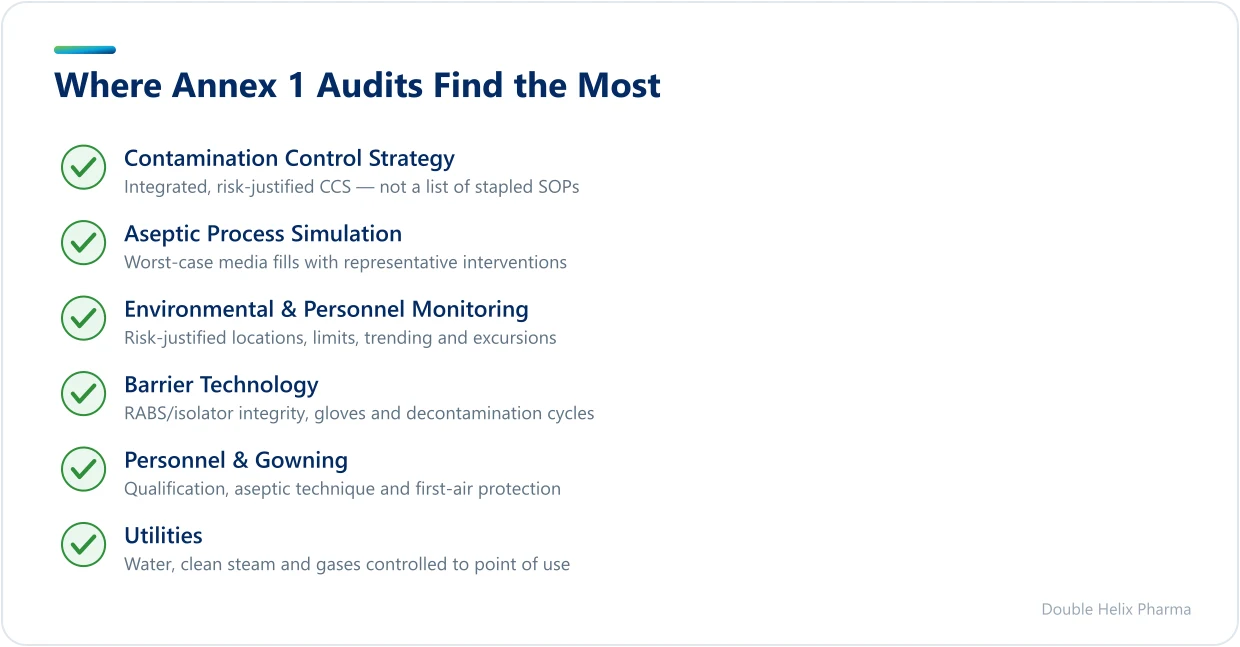
Where Annex 1 audits find the most
Recurring findings in sterile audits tend to fall into a small number of high-value areas. Focusing your time here usually surfaces the issues that matter most to patient safety.
- Aseptic process simulation (media fills): insufficient worst-case challenge, interventions not representative of routine and non-routine practice, incomplete line-clearance, or unconvincing investigation of any contaminated unit.
- Environmental and personnel monitoring: sample locations not justified by risk, alert and action limits set without sound rationale, weak trending, and a disconnect between excursions and the deviation system.
- Barrier technology: RABS or isolator integrity, glove management and testing, transfer practices, and decontamination cycle validation that does not reflect the loaded configuration.
- Personnel behaviour and gowning: qualification and requalification gaps, aseptic technique under real conditions, and movement that undermines first-air protection.
- Utilities: water systems, clean steam and compressed gases that are monitored but not demonstrably controlled to the point of use.
The most revealing question in any sterile audit is rarely "is there a procedure?" — it is "show me the last time this went wrong, and what you did about it." Deviations, excursions and media-fill investigations expose whether the control strategy works under pressure.
Auditing on the floor: people, behaviour and data
Documentation tells you what the site intends; the cleanroom tells you what actually happens. Where it is safe and permitted to observe aseptic operations, watch interventions, transfers and gowning against the written aseptic technique and the assumptions baked into the media fill. A simulation that never modelled the interventions you witness is a significant gap, irrespective of how clean the recent fills appear on paper.
Following the data trail
Sterile manufacturing generates exactly the kind of data that ALCOA+ principles are designed to protect. Probe whether environmental monitoring results, weighing records, filling parameters and integrity-test data are attributable, contemporaneous and complete, and whether audit trails on monitoring and filling equipment are reviewed rather than merely enabled. A pattern of "repeat" samples after an out-of-limit result, with no investigation, is a classic data-integrity and contamination-control failure rolled into one. Our wider perspective on these recurring themes is set out across our case studies, which show how sites close such gaps in practice.
Scoping and planning a credible Annex 1 audit
Annex 1 covers a great deal, and few audits have time to test everything to the same depth. Use quality risk management to focus: prioritise the dosage forms, processes and systems with the greatest sterility-assurance impact, and the areas with a weak history of deviations or change. A typical structure runs from CCS and quality-system review, through facility and utility design, to aseptic processing, monitoring, and finally the people who execute it.
Auditor competence is itself a control. Sterile auditing demands genuine understanding of aseptic processing, microbiology and barrier technology; a generalist checklist applied without that background tends to confirm the obvious and miss the substantive. Where importers and marketing authorisation holders are qualifying overseas sterile sites, the same depth must survive translation into a remote or hybrid format. For a fuller view of how we structure this work, see our GMP audit service and the broader range of compliance services that support sterile manufacturers.
Key takeaways
A modern Annex 1 audit is, at heart, a test of whether a sterile manufacturer can argue — and evidence — a coherent contamination control strategy from facility to fingertip. Lead with the CCS, follow the highest-risk threads onto the floor, and let deviations and media-fill investigations tell you whether the controls hold under real conditions. Done well, it protects patients and the licence in equal measure; done as a checklist, it offers false assurance.
If you are preparing a sterile site for inspection, qualifying a contract manufacturer, or want an independent read on your contamination control strategy, our Qualified Persons can help. Contact Double Helix Pharma UK to discuss a focused, risk-based Annex 1 audit.
Regulatory sources
This guidance reflects current UK and EU GMP/GDP requirements. Primary references:
- EU GMP Annex 1 — Manufacture of Sterile Medicinal Products
- EudraLex Volume 4 — EU GMP Guidelines
- EU GMP Chapter 9 — Self Inspection
- MHRA Inspectorate Blog
Always confirm against the latest published version of each source.
Frequently asked questions
What is the most important document to review in an Annex 1 audit?+
The Contamination Control Strategy (CCS) is the anchor of any modern Annex 1 audit and should be reviewed first. A credible CCS names the microbial, particulate and endotoxin hazards relevant to the site and explains why the chosen controls are adequate and how their effectiveness is verified. If the strategy is simply a list of existing SOPs rather than an integrated, risk-justified argument, that is itself a significant finding.
Does the revised Annex 1 apply to contract manufacturers and importers?+
Yes. Any site performing sterile manufacturing within scope of EU GMP is expected to meet the revised Annex 1, including contract manufacturers. Marketing authorisation holders and importers remain accountable for qualifying and overseeing those sites, so a risk-based Annex 1 audit of a contract sterile manufacturer is a core part of supplier management rather than an optional extra.
How does quality risk management fit into a sterile audit?+
Quality risk management, in line with ICH Q9, runs through the whole of Annex 1 and should also shape how the audit is scoped. Auditors use risk to prioritise the dosage forms, processes and systems with the greatest sterility-assurance impact, rather than testing everything to equal depth. The site, in turn, should be able to show that its monitoring locations, limits and interventions are justified by documented risk assessment.