Contract QP, RP & RPi · 7 min read
QP Eligibility and the Viva: How Assessment Works
How the QP viva and eligibility assessment work: the degree, experience, sponsor and panel interview that confirm you are fit to certify batches.
By Balasubramanian Ramaiah · 9 June 2026 · Updated 19 August 2026
For most aspiring Qualified Persons, the QP viva is the moment that decides everything: a structured professional interview in which a panel tests whether your knowledge, judgement and experience are genuinely fit to certify batches under EU GMP. It is not an academic exam to be crammed for, but an assessment of practitioner readiness. This article sets out how eligibility and the viva actually work, so quality teams can plan resourcing and support candidates realistically.
Eligibility before you reach the viva
The viva is the final gate, not the first. Before a candidate is put forward, they must satisfy the structural eligibility criteria set out in UK and EU medicines legislation and assessed jointly by the three professional bodies that run the scheme.
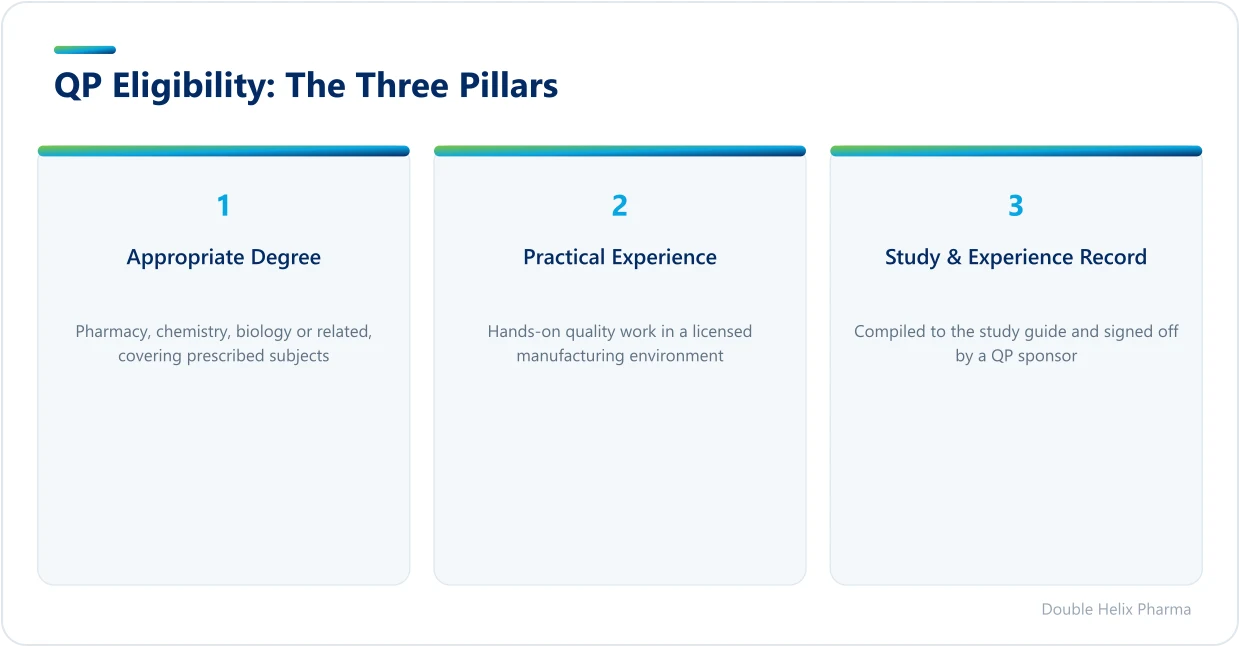
In practice, eligibility rests on three pillars:
- An appropriate degree in pharmacy, chemistry, biology, medicine or a related discipline that covers the prescribed underpinning subjects, including pharmaceutical analysis, microbiology and pharmacology.
- Relevant practical experience in a licensed manufacturing environment, including a minimum period of hands-on quality work in qualitative and quantitative analysis and quality assurance.
- A study and experience record compiled against the joint study guide and signed off by an experienced QP sponsor who knows the candidate's work.
Only once that documented case is accepted does the candidate progress to interview. A weak or thinly evidenced record is the most common reason a viva goes badly, because the panel will probe exactly the gaps the paperwork reveals.
The role of the QP sponsor
A nominated sponsor, normally a practising QP within the candidate's organisation, is central to the scheme. The sponsor confirms that the candidate has genuinely performed the activities claimed, not merely observed them, and shapes a development plan that fills gaps over the months before assessment.
Good sponsorship is hands-on. It means rotating a candidate through unfamiliar dosage forms, exposing them to live deviation and recall decisions, and rehearsing the kind of reasoning the panel will demand. Sites that treat sponsorship as a signature on a form, rather than a structured mentoring relationship, tend to send candidates in underprepared.
How the QP viva is structured
The eligibility viva is a panel interview, typically led by assessors drawn from the professional bodies, each an experienced QP in their own right. It is a professional conversation rather than a written test, and its purpose is to confirm that the candidate can apply knowledge to real decisions under questioning.
What the panel is really testing
Assessors are not looking for textbook recitation. They are testing judgement: can you weigh conflicting evidence, recognise the limits of your own competence, and explain why you would or would not certify a batch? Expect the conversation to range across:
- The legal basis of certification and the QP's personal accountability under EU GMP Annex 16.
- Application of ICH Q9 quality risk management and ICH Q10 pharmaceutical quality system principles to live scenarios.
- Data integrity and ALCOA+ expectations when reviewing records and audit trails.
- Contemporary GMP topics such as Annex 1 for sterile products, where relevant to the candidate's experience.
- Supply-chain and importation controls, and the interface with GDP guidelines.
Scenario and judgement questions
Much of the viva turns on "what would you do" scenarios: an out-of-specification result discovered after dispatch, a supplier deviation, a borderline stability signal, or pressure to release against an incomplete investigation. The panel wants to hear a defensible reasoning process, an awareness of when to escalate, and the confidence to refuse release when the evidence does not support it.
The QP who can say "I would not certify, and here is precisely why" demonstrates more competence than one who reaches for a textbook answer to please the panel.
Preparing candidates for the QP viva
Preparation is a programme, not a revision sprint. The most effective approach blends documented experience with deliberate exposure to decisions a candidate has not yet faced.
- Map the study guide against real experience and identify honest gaps early, while there is time to address them.
- Broaden practical exposure across dosage forms, technologies and quality events, rather than relying on a single product line.
- Rehearse reasoning aloud through mock vivas with experienced QPs who will challenge weak answers.
- Stay current with evolving guidance such as Annex 1 and data-integrity expectations, and be ready to discuss how they change practice.
For organisations building this capability, our contract QP service can provide experienced QPs who act as sponsors, run realistic mock vivas, and steady a quality function while a candidate works towards assessment. Examples of how we have supported teams through transitions are set out in our case studies.
What happens after the assessment
A successful candidate is confirmed as eligible to act as a QP and can then be named on a Manufacturer's or Importer's Authorisation, becoming personally accountable for certifying batches. If the panel identifies specific weaknesses, the outcome may be a deferral with targeted feedback, allowing the candidate to gain experience in the areas flagged before a further attempt.
It is worth remembering that passing the viva is a beginning, not a destination. Certification is an ongoing professional responsibility, and a QP is expected to maintain current knowledge and act within their genuine areas of competence for the lifetime of their practice. You can see how this role sits within the wider quality function across our consultancy services.
Key takeaways
The QP viva tests practitioner judgement, not memorised facts, and a well-evidenced experience record is the foundation of a confident performance. Strong sponsorship, broad practical exposure and honest rehearsal matter far more than last-minute revision. If your organisation needs to support a candidate towards assessment, cover a vacant QP role, or strengthen its release decision-making in the meantime, contact our team to discuss how an experienced contract QP can help.
Regulatory sources
This guidance reflects current UK and EU GMP/GDP requirements. Primary references:
- EU GMP Annex 16 — Certification by a Qualified Person and Batch Release
- EMA — GMP/GDP Questions & Answers
- EudraLex Volume 4 — EU GMP Guidelines
Always confirm against the latest published version of each source.
Frequently asked questions
What is the QP viva?+
The QP viva is a structured panel interview that forms the final stage of the eligibility assessment to become a Qualified Person in the UK. Experienced QP assessors from the professional bodies test whether a candidate can apply knowledge to real certification decisions under questioning, rather than simply recite theory. It follows a documented case of degree, experience and a signed study record, and confirms the candidate is genuinely fit to certify batches under EU GMP.
How should you prepare for the QP viva?+
Treat preparation as a programme rather than last-minute revision. Map your experience honestly against the joint study guide, broaden your exposure across dosage forms and quality events such as deviations and recalls, and rehearse your reasoning aloud through mock vivas with an experienced QP. The panel rewards defensible judgement and a clear grasp of when to escalate or refuse release far more than memorised answers.
What happens if you do not pass the QP viva?+
An unsuccessful candidate is usually given specific feedback identifying the areas of weakness, rather than a simple pass or fail. This typically results in a deferral, allowing time to gain targeted experience in the flagged topics before a further attempt. Working with an experienced sponsor to address those gaps systematically is the most reliable route to success on the next assessment.