QMS & PQS Implementation · 7 min read
ICH Q10 Explained: The Pharmaceutical Quality System
ICH Q10 explained: the four elements, two enablers and management responsibility behind an effective pharmaceutical quality system under EU GMP and MHRA.
By Balasubramanian Ramaiah · 9 June 2026 · Updated 17 July 2026
Most quality teams can recite the four elements of a pharmaceutical quality system from memory, yet still struggle to explain how ICH Q10 actually changes the way a site is run. That is the gap this article closes. ICH Q10 is not a standalone regulation to be filed away; it is the framework that turns a folder of standard operating procedures into a living quality system that holds up across the entire product lifecycle and under regulatory scrutiny.
What ICH Q10 actually is
ICH Q10, Pharmaceutical Quality System, is the International Council for Harmonisation guideline that describes a comprehensive model for an effective quality management system across the product lifecycle. It builds on ISO quality concepts, incorporates Good Manufacturing Practice, and links directly to its sister guidelines ICH Q8 (Pharmaceutical Development), ICH Q9 (Quality Risk Management) and ICH Q11 (development and manufacture of drug substances). In the EU it sits within EU GMP as Part III, which gives it real regulatory standing rather than the status of optional best practice.
The guideline applies across four lifecycle stages: pharmaceutical development, technology transfer, commercial manufacturing, and product discontinuation. Crucially, it is intended to be applied in a manner proportionate to each stage, recognising that the controls appropriate for a development product differ from those needed for a mature commercial line. It is a model, not a checklist, and that distinction matters when you implement it.
The four elements of the pharmaceutical quality system
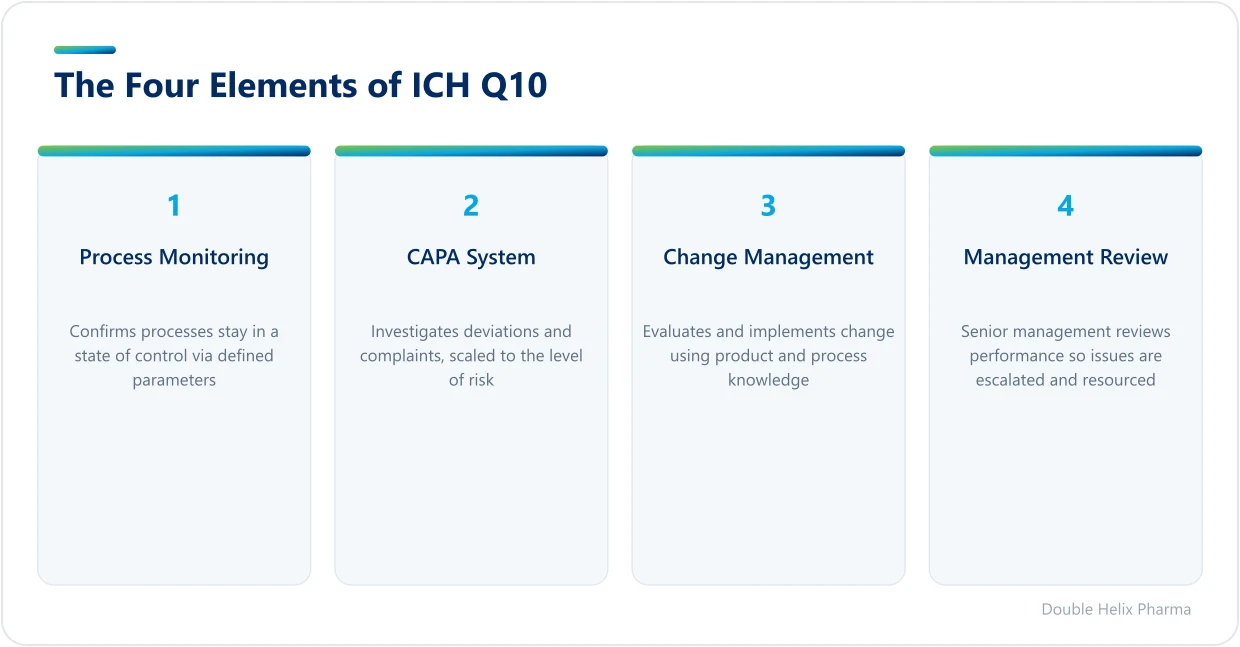
At the heart of ICH Q10 are four interlinked elements that, taken together, allow a company to maintain a state of control and drive continual improvement. These are not new activities for most sites, but Q10 expects them to be connected, measured and managed as a system.
- Process performance and product quality monitoring system: a planned approach to monitoring that confirms processes remain in a state of control, using parameters and attributes defined during development and informed by quality risk management.
- Corrective action and preventive action (CAPA) system: a structured methodology for investigating complaints, deviations, non-conformities, recalls and audit findings, with the rigour of the investigation matched to the level of risk.
- Change management system: a system to evaluate, approve and implement changes to products and processes using product and process knowledge, so that change is enabled rather than feared.
- Management review: the periodic review of process performance and product quality, and of the quality system itself, by senior management so that issues are escalated and resourced.
The point of naming these four elements is integration. A CAPA that never feeds management review, or a change that is made without reference to process monitoring data, is a symptom of a quality system that exists on paper but not in practice.
Two enablers: knowledge and risk management
ICH Q10 identifies two enablers that run through the entire model: knowledge management and quality risk management. They are what make the four elements work rather than simply exist.
Knowledge management
Product and process knowledge should be managed from development through to discontinuation, and across technology transfer in particular. This includes prior knowledge, development studies, manufacturing experience, and data generated during routine production. When a process is transferred to a contract manufacturer, it is the structured transfer of this knowledge, not just the master batch record, that determines whether the receiving site can sustain a state of control.
Quality risk management
Quality risk management, described in detail in ICH Q9, is the systematic process for the assessment, control, communication and review of risks to quality. Under ICH Q10 it is applied proactively: to prioritise monitoring, to scale CAPA investigations, to evaluate the impact of changes, and to focus management attention where it matters most. Risk management is the thread that keeps the system proportionate.
Management responsibility and the state of control
One feature that distinguishes ICH Q10 from a purely procedural reading of GMP is the explicit emphasis on management responsibility. Senior management is accountable for the quality system, for establishing a quality policy and quality objectives, for providing adequate resources and training, and for conducting meaningful management reviews. This is not a delegation to the quality unit; it is a leadership obligation written into the model.
Two outcomes define a healthy pharmaceutical quality system under Q10. The first is achieving and maintaining a state of control, where monitoring and control systems provide ongoing assurance of process performance and product quality. The second is enabling continual improvement, where the organisation identifies and implements appropriate product quality and process improvements, variability reductions and innovations.
A quality system that cannot demonstrate both a state of control and genuine continual improvement is, in ICH Q10 terms, incomplete, no matter how thick the SOP binder.
Inspectors increasingly probe for evidence that these outcomes are real. They will ask to see the quality metrics that feed management review, the trend data behind a CAPA decision, and the rationale that scaled a particular change. A robust quality management system implementation anticipates these questions by designing the evidence in from the start, rather than reconstructing it before an inspection.
Implementing ICH Q10 in a UK and EU context
For UK and EU manufacturers, importers and contract organisations, ICH Q10 is operationalised through EU GMP Part III, with the MHRA expecting the principles to be embedded in everyday practice. Implementation rarely fails for lack of procedures; it fails because the elements are not connected, ownership is unclear, or data integrity is too weak to trust the monitoring outputs.
A pragmatic implementation tends to follow a recognisable path:
- Gap assessment: map your current quality system against the four elements and two enablers, and against the relevant chapters of EU GMP, to identify where integration is missing.
- Data integrity foundation: ensure the records that feed monitoring and review meet ALCOA+ expectations, so that decisions rest on data that is attributable, legible, contemporaneous, original and accurate.
- Define ownership and metrics: assign clear owners for each element and agree the quality metrics that will demonstrate a state of control and surface adverse trends early.
- Connect the loops: ensure deviations, CAPA, change control and process monitoring feed a management review that actually allocates resources and drives improvement.
- Embed across the lifecycle: extend the same discipline to technology transfer and, eventually, product discontinuation, so the system is coherent from development to end of life.
For sterile products, the same principles intersect with the revised Annex 1 contamination control strategy, which is in effect a focused application of quality risk management and process monitoring. ICH Q10 gives you the management framework into which that strategy fits.
Key takeaways
Understood properly, ICH Q10 is the operating system of a modern pharmaceutical quality function: four connected elements, two enablers, and visible management responsibility, all aimed at maintaining a state of control and driving continual improvement across the lifecycle. Treating it as a regulation to be filed misses the point; treating it as the way the site is run is what satisfies both your patients and your inspectors.
If you are building, remediating or maturing your pharmaceutical quality system, our independent UK Qualified Persons can help you turn the Q10 model into working practice. Explore our QMS and PQS implementation service, see how we have supported manufacturers and importers in our case studies, or review the full range of quality and compliance services we provide. When you are ready to strengthen your quality system, get in touch with our team for a confidential, practical discussion.
Regulatory sources
This guidance reflects current UK and EU GMP/GDP requirements. Primary references:
- EU GMP Chapter 1 — Pharmaceutical Quality System
- EudraLex Volume 4 — EU GMP Guidelines
- EMA — GMP/GDP Questions & Answers
Always confirm against the latest published version of each source.
Frequently asked questions
What is the difference between ICH Q9 and ICH Q10?+
ICH Q9 is the guideline on quality risk management, describing how to assess, control, communicate and review risks to product quality. ICH Q10 is the broader pharmaceutical quality system model, and it uses quality risk management as one of its two enablers. In short, Q9 is a core methodology and Q10 is the management framework that applies that methodology across the product lifecycle.
Is ICH Q10 legally binding in the UK and EU?+
ICH Q10 is adopted within EU GMP as Part III, which gives it clear regulatory standing for manufacturers and importers operating to EU GMP, and the MHRA expects its principles to be embedded in practice in Great Britain. While it is written as a model rather than a prescriptive rule, inspectors will look for evidence that its elements are genuinely implemented. Treating it as optional best practice is therefore a mistake.
What are the four elements of the ICH Q10 pharmaceutical quality system?+
The four elements are the process performance and product quality monitoring system, the corrective action and preventive action (CAPA) system, the change management system, and management review. ICH Q10 expects these to operate as a connected system rather than as isolated procedures, supported by the two enablers of knowledge management and quality risk management. Together they allow a site to maintain a state of control and pursue continual improvement.