Supplier & Vendor Management · 7 min read
Vendor Performance KPIs for Quality Teams
How to design vendor KPIs that give pharma quality teams inspection-ready, risk-weighted supplier oversight aligned with EU GMP, GDP and ICH Q9/Q10.
By Balasubramanian Ramaiah · 9 June 2026 · Updated 26 July 2026
Vendor KPIs are the early-warning system of a pharmaceutical quality organisation: they turn the qualitative confidence you place in a supplier into measurable, defensible evidence. Done well, a vendor KPI programme tells you which suppliers are quietly drifting before a deviation becomes a recall, and gives your quality management review the hard data it needs. Done badly, it produces a tidy dashboard that nobody trusts and no one acts on.
Why vendor KPIs matter to a regulated quality team
Under EU GMP Chapter 5 and Chapter 7, the contract giver retains ultimate responsibility for the quality of materials and outsourced activities, regardless of who physically performs the work. That responsibility cannot be discharged by a single qualification audit conducted three years ago. Supplier performance is dynamic: people leave, lines are revalidated, raw-material sources shift, and quality systems erode under commercial pressure. Continuous monitoring through defined metrics is how you demonstrate the ongoing control that inspectors expect.
The principle is reinforced across the framework. ICH Q10 frames supplier management as part of the pharmaceutical quality system and explicitly links it to management review and continual improvement. ICH Q9 expects you to focus effort where risk is greatest. GDP guidelines apply the same logic to the distribution chain, where qualification of suppliers and customers must be supported by evidence over time. KPIs are simply the mechanism that operationalises these expectations.
The core vendor KPIs worth tracking
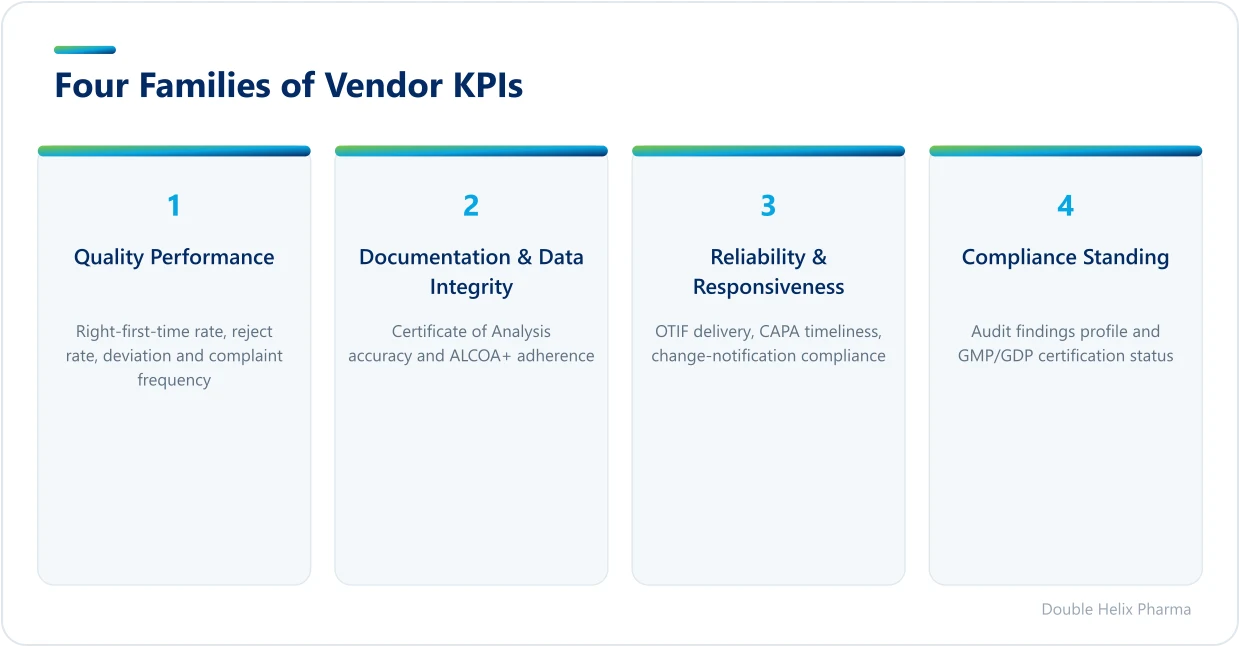
Resist the temptation to measure everything. A focused set of indicators, each tied to a decision you will actually make, beats a sprawling scorecard. In practice, most quality teams converge on four families of metric.
Quality performance
- Right-first-time (RFT) rate — the percentage of batches, shipments or deliverables accepted without rework or query. The single most informative leading indicator of supplier health.
- Confirmed defect or reject rate — out-of-specification results, damaged goods or documentation failures attributable to the supplier, normalised per lot or per consignment.
- Deviation and complaint frequency — events raised against the supplier, trended over a rolling period rather than viewed in isolation.
Documentation and data integrity
- Certificate of Analysis accuracy and timeliness — errors, omissions or transcription mismatches against your own incoming testing.
- ALCOA+ adherence — observations from audits or document review where records were not attributable, legible, contemporaneous, original or accurate. Persistent data-integrity weaknesses are a far more serious signal than an occasional typographical error.
Reliability and responsiveness
- On-time in-full (OTIF) delivery — a supply-chain metric with direct quality consequences, since shortages drive risky workarounds.
- CAPA timeliness and effectiveness — how quickly the supplier acknowledges, investigates and closes corrective actions, and whether issues recur.
- Change-notification compliance — whether the supplier notifies you of changes in advance, as required by your quality agreement.
Compliance standing
- Audit findings profile — number, classification and recurrence of observations across successive audits.
- Regulatory and certification status — currency of GMP/GDP certificates, manufacturing or wholesale dealer's authorisations, and any adverse inspection outcomes.
Designing vendor KPIs that drive action, not decoration
A metric only earns its place if it changes behaviour. Three design principles separate useful vendor KPIs from dashboard wallpaper.
Define each metric precisely. State the numerator, denominator, data source and exclusion rules in a procedure. If two analysts would calculate your RFT rate differently, the number is meaningless. Ambiguity is also where disputes with suppliers begin.
Set thresholds and a response. Every KPI needs a target, an alert level and an action level — and a documented consequence at each. A red rating that triggers nothing teaches everyone, including your suppliers, that the scorecard is theatre. Tie thresholds to escalation: a supplier corrective action request, an unannounced for-cause audit, or a formal review of approved status.
Weight by risk. Following ICH Q9, a sterile API manufacturer subject to Annex 1 expectations should not be assessed against the same criticality as a supplier of secondary packaging. Segment your vendor base by criticality and apply proportionate monitoring frequency, thresholds and audit cadence. This keeps scarce quality resource pointed at the risks that matter.
The goal is not a perfect score; it is an honest one. A KPI programme that never shows red is not evidence of excellent suppliers — it is usually evidence of thresholds set too generously to be useful.
Turning data into decisions: governance and review
Metrics generate value only at the point of review. Build a regular performance review for each critical supplier, with the cadence scaled to risk, and feed the aggregate picture into your formal management review under ICH Q10. The output should not be a passive report but a set of decisions: maintain, monitor, escalate, re-audit or, where justified, disqualify.
Trending is essential. A single poor month is noise; a three-quarter decline in right-first-time is a signal that warrants intervention before it manifests as a batch failure. Where you operate in a contract environment as a CMO or importer, your quality agreement should make the KPI set, thresholds and review rights explicit, so that monitoring is a contractual entitlement rather than a polite request. Robust supplier management ties these threads together — qualification, the quality agreement, ongoing KPIs and periodic re-evaluation as one continuous loop rather than disconnected activities. You can see how this works in practice across our case studies, and how it sits within our wider range of services.
Common pitfalls and how to avoid them
- Vanity metrics. Tracking what is easy to count rather than what predicts risk. Always ask: what decision does this number inform?
- Lagging-only indicators. Reject rates tell you the harm has already occurred. Balance them with leading signals such as change-notification compliance and audit-finding trends.
- Data integrity in the KPIs themselves. Manually re-keyed scorecards are vulnerable to the very ALCOA+ failings you audit suppliers for. Source data from validated systems where possible.
- No feedback loop to the supplier. Performance data shared transparently, with clear expectations, tends to improve behaviour. Data hoarded internally rarely does.
Key takeaways
Well-designed vendor KPIs convert supplier oversight from an annual ritual into continuous, inspection-ready assurance. Keep the set small, precise and risk-weighted; attach real consequences to thresholds; and review trends through your pharmaceutical quality system so that data becomes decisions. Above all, treat the programme as a living control aligned with EU GMP, GDP and ICH Q9/Q10, not a chart to satisfy an auditor.
If you are building or sharpening a supplier monitoring programme — or want an independent QP's review of whether your current vendor KPIs would withstand MHRA scrutiny — get in touch with our team to discuss a practical, proportionate approach.
Regulatory sources
This guidance reflects current UK and EU GMP/GDP requirements. Primary references:
- EU GMP Chapter 7 — Outsourced Activities
- EU GMP Part II — Active Substances (APIs)
- EMA — GMP/GDP Questions & Answers
Always confirm against the latest published version of each source.
Frequently asked questions
How many vendor KPIs should a pharma quality team track per supplier?+
Fewer than most teams expect. A focused set of four to eight metrics across quality, data integrity, reliability and compliance is far more effective than a sprawling scorecard nobody trusts. Each KPI should tie to a specific decision you will make, and the number should be weighted by supplier criticality under ICH Q9, so your most critical suppliers receive deeper monitoring than low-risk ones.
What is the difference between leading and lagging vendor KPIs?+
Lagging indicators, such as reject rates and confirmed complaints, measure harm that has already occurred, while leading indicators, such as change-notification compliance and audit-finding trends, help you anticipate problems before they cause a batch failure. A robust programme balances both. Relying only on lagging metrics means you are always reacting rather than preventing, which undermines the continual-improvement intent of ICH Q10.
Are vendor KPIs a regulatory requirement under EU GMP and GDP?+
There is no rule prescribing a specific list of KPIs, but EU GMP Chapters 5 and 7 and the GDP guidelines require ongoing control and qualification of suppliers, and ICH Q10 expects supplier performance to feed management review. KPIs are the practical mechanism for evidencing that continuous oversight. Inspectors will expect to see that you monitor critical suppliers over time and act on the data, not merely that you audited them once.