Supplier & Vendor Management · 7 min read
When and How to Disqualify a Supplier
A practical QP guide to supplier disqualification: when to trigger it under ICH Q9 and Q10, how to do it without disrupting supply, and the path back.
By Balasubramanian Ramaiah · 9 June 2026 · Updated 5 August 2026
Knowing how to qualify a supplier is routine; knowing when and how to remove one is where many quality systems fall short. Supplier disqualification is the formal, evidence-based decision to withdraw a supplier's approved status when they can no longer be relied upon to meet your quality requirements. Done well, it protects patients, product and your licence; done badly, or not at all, it leaves an indefensible supply chain that an MHRA inspector will find quickly.
What supplier disqualification actually means
Disqualification is the deliberate reversal of the approval you granted during qualification. It is not the same as a routine failure to re-qualify on schedule, nor is it a punitive gesture. It is a controlled quality decision, taken under your quality management system in line with ICH Q10, that a supplier no longer belongs on your approved supplier list for some or all of what they provide.
Crucially, disqualification sits on a spectrum of supplier-status actions. Before you reach for it, decide whether the situation warrants a lesser measure, because removing a sole-source supplier of a critical active substance has very different consequences from dropping one of several packaging vendors.
The escalation ladder
- Probation or enhanced monitoring: tightened incoming testing, reduced order volumes, or a shortened re-audit interval while the supplier proves recovery.
- Conditional or restricted approval: approval limited to specific materials, sites or volumes pending corrective action.
- Suspension: a temporary hold on new orders while a serious issue is investigated, reversible if the supplier remediates.
- Full disqualification: permanent removal from the approved supplier list, used when confidence cannot reasonably be restored.
Defining this ladder in your supplier management procedure means decisions are consistent and defensible rather than reactive. Our supplier management service can help you build these tiers and the criteria that move a supplier between them.
When to disqualify a supplier
The trigger should always be a documented, risk-assessed conclusion rather than a single bad day. Apply ICH Q9 principles to weigh severity, detectability and the likelihood of recurrence. The following situations commonly justify moving towards disqualification.
Quality and compliance triggers
- Confirmed data integrity breaches: falsified records, backdated data or testing-into-compliance that offend ALCOA+ are rarely recoverable and frequently warrant immediate suspension pending disqualification.
- Repeated or unresolved critical and major findings: a pattern of the same GMP or GDP deficiencies across audits, or a critical finding the supplier cannot or will not close.
- Adverse regulatory action: a suspended or revoked authorisation, a damning inspection outcome, or import restrictions affecting the site.
- Recurring product failures: persistent out-of-specification results, confirmed complaints, or a recall traceable to the supplier.
- Loss of transparency: refusal to be audited, withholding of information, or unnotified changes to processes, sites or sub-contractors that breach your quality or technical agreement.
For sterile and high-risk products, a collapse in the contamination control strategy expected under Annex 1, or for US-bound product a serious lapse against 21 CFR 210/211, should weigh heavily. Distribution partners are judged against the same logic under GDP guidelines, where breaks in the cold chain or falsified-medicines safeguards are equally serious.
A single critical finding can justify disqualification; a series of unaddressed minors can justify it just as firmly. It is the supplier's response, not only the finding, that tells you whether confidence is recoverable.
How to disqualify a supplier without disrupting supply
The hardest disqualifications are the necessary ones involving critical or sole-source suppliers. The quality decision and the continuity decision must be made together, never traded against each other. Follow a controlled sequence.
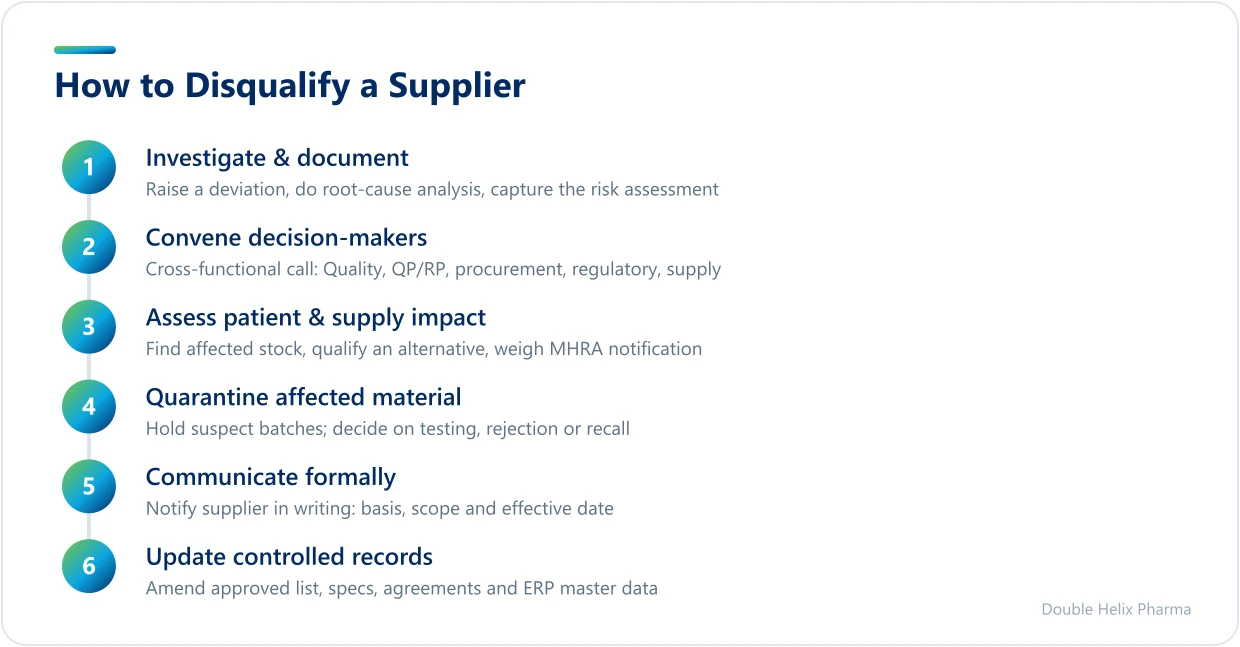
- Investigate and document the rationale. Raise a deviation or quality event, complete root-cause analysis, and capture the risk assessment that supports the decision. The record must stand on its own months later.
- Convene the right decision-makers. Disqualification of a critical supplier is a cross-functional call involving Quality, the Qualified Person or Responsible Person, procurement, regulatory and supply-chain leads, formally minuted.
- Assess patient and supply impact first. Identify affected products and stock, qualify an alternative source, and consider whether a managed phase-out or a notification to the MHRA is required to avoid a shortage.
- Quarantine and bracket affected material. Where integrity is in question, place suspect batches on hold and decide on additional testing, rejection or recall before any further use.
- Communicate formally. Notify the supplier in writing, stating the basis for disqualification, the scope, the effective date and any return, complaint or close-out obligations under the agreement.
- Update controlled records. Amend the approved supplier list, specifications, the relevant quality or technical agreements and your ERP master data so no further orders can be raised.
The phasing matters. Suspend ordering immediately when patient safety is at risk, but sequence the formal exit so that a qualified alternative is in place before supply is interrupted. This is precisely the balance our case studies illustrate when a critical supplier had to be replaced under time pressure.
Documentation, governance and the inspector's view
An inspector will not simply ask whether you disqualified a poor supplier; they will ask to see the decision trail. Expect scrutiny of the originating quality event, the risk assessment, the approval signatures, the impact assessment on existing stock, and evidence that your approved supplier list and agreements were updated promptly. Weak documentation here undermines an otherwise sound decision.
Governance should run through your management review under ICH Q10, so that supplier performance trends, escalations and disqualifications are visible to senior management and feed back into qualification criteria. The closed loop, from qualification through monitoring and escalation to disqualification, is what demonstrates genuine control of outsourced activities under EU GMP Chapter 7. If you are strengthening this end to end, our wider consultancy services can align your procedures, agreements and oversight.
Common pitfalls
- Leaving a failing supplier "approved" on paper because removing them is inconvenient.
- Disqualifying informally by email, with no deviation, risk assessment or governance record.
- Stopping orders but failing to address batches already received and in stock.
- No defined route to requalification, so a recovered supplier is either excluded forever or quietly reinstated without justification.
Re-approval and the path back
Disqualification need not always be permanent. Where the cause was remediable, set out objective requalification criteria: independently verified CAPA, a successful follow-up audit, a sustained period of acceptable performance and, where relevant, evidence of a satisfactory regulatory inspection. Re-approval should be a fresh, documented qualification decision, not a reversal granted on goodwill. Confirmed data integrity fraud, however, will usually close that door for good.
Key takeaways
Effective supplier disqualification is a controlled, risk-based quality decision, not an afterthought. Anchor it in ICH Q9 and ICH Q10, define a clear escalation ladder, protect supply continuity, and document every step to a standard an inspector can follow.
- Use a defined ladder from enhanced monitoring through suspension to full disqualification.
- Trigger on confirmed data integrity breaches, repeated unresolved findings, adverse regulatory action and loss of transparency.
- Make the quality decision and the supply-continuity decision together, with a qualified alternative ready.
- Keep a complete decision trail and route governance through management review.
If you need experienced QPs and RPs to design your escalation criteria, manage a difficult supplier exit, or defend your supplier oversight at inspection, explore our supplier management service or get in touch with our team to discuss your requirements.
Regulatory sources
This guidance reflects current UK and EU GMP/GDP requirements. Primary references:
- EU GMP Chapter 7 — Outsourced Activities
- EU GMP Part II — Active Substances (APIs)
- EMA — GMP/GDP Questions & Answers
Always confirm against the latest published version of each source.
Frequently asked questions
What is the difference between suspending and disqualifying a supplier?+
Suspension is a temporary hold on new orders while a serious issue is investigated, and it is reversible if the supplier remediates effectively. Disqualification is the permanent removal of a supplier from your approved supplier list because confidence cannot reasonably be restored. Suspension is often the immediate protective step taken while you gather the evidence and risk assessment that may or may not lead to full disqualification.
Can a disqualified supplier ever be re-approved?+
Yes, where the original cause was remediable rather than fraudulent. Re-approval should be treated as a fresh, documented qualification decision supported by independently verified CAPA, a successful follow-up audit and a sustained period of acceptable performance. Confirmed data integrity fraud, by contrast, will usually prevent re-approval permanently because it undermines trust in everything the supplier reports.
How do you disqualify a sole-source critical supplier without causing a shortage?+
Make the quality decision and the supply-continuity decision together rather than trading one against the other. Suspend ordering immediately if patient safety is at risk, but sequence the formal exit so a qualified alternative source is in place first, and assess whether the MHRA needs to be notified of a potential shortage. The affected stock already held must also be risk-assessed, quarantined where necessary, and dispositioned before the transition is complete.