Supplier & Vendor Management · 7 min read
Ongoing Supplier Monitoring and Performance
A senior QP guide to ongoing supplier monitoring: risk-based metrics, QMS integration, escalation and CAPA to keep your pharma supply chain inspection-ready.
By Balasubramanian Ramaiah · 9 June 2026 · Updated 22 August 2026
Approving a supplier is the start of the relationship, not the end of the work. Effective supplier monitoring turns a one-off qualification decision into a living judgement about whether a vendor still merits your trust, batch after batch and year after year. This article sets out how UK and EU quality teams can build ongoing monitoring and performance management that satisfies EU GMP and GDP expectations while genuinely reducing supply risk.
Why ongoing supplier monitoring matters
Initial qualification captures a supplier at a single moment. Sites change ownership, lose key staff, defer capital investment and quietly drift away from the state in which you assessed them. EU GMP Chapter 5 and Chapter 7 are explicit that the contract giver retains responsibility for assessing the competence and compliance of contract acceptors and suppliers on a continuing basis, and the GDP guidelines (2013/C 343/01) place equivalent duties on distributors verifying their supply chain.
Monitoring is also where the principles of ICH Q9 quality risk management meet day-to-day reality. A supplier risk rating set at approval is a hypothesis; performance data is the evidence that either confirms it or tells you the risk has moved. Without that feedback loop, your supplier file becomes a historical document rather than a control.
Defining performance metrics that actually matter
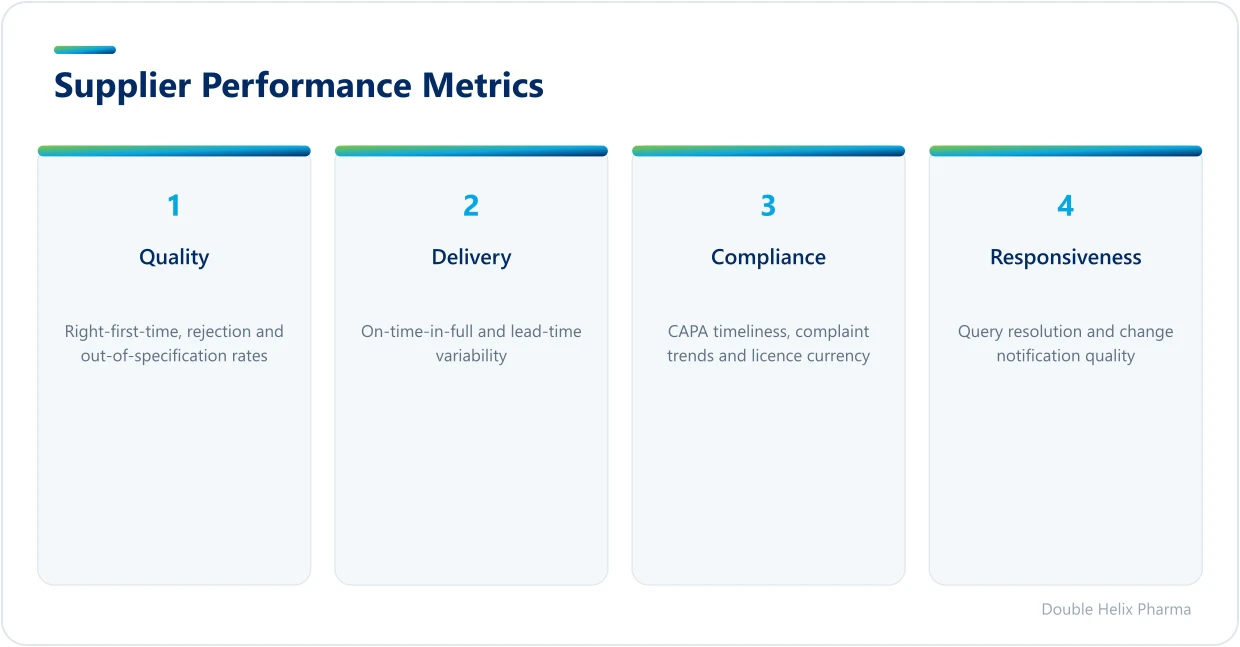
The fastest way to undermine a monitoring programme is to measure everything and act on nothing. Select a small set of indicators that map to the risks a given supplier presents, and tie each to a defined threshold and an owner. For most material and service suppliers the core set includes:
- Quality — right-first-time rate, confirmed defect or rejection rate, out-of-specification frequency and the proportion of certificates of analysis requiring query.
- Delivery — on-time-in-full performance, lead-time variability and short-notice change requests.
- Compliance — deviation and CAPA closure timeliness, complaint trends, recall involvement and the currency of licences and certifications.
- Responsiveness — time to acknowledge and resolve queries, and the quality of change notifications received under the technical or quality agreement.
Underpinning all of these is data integrity. Certificates, test results and notifications should meet ALCOA+ expectations: attributable, legible, contemporaneous, original and accurate, and then complete, consistent, enduring and available. A supplier that cannot produce trustworthy records is a quality risk regardless of how good the headline numbers look.
Risk-based monitoring intensity
Not every supplier warrants the same scrutiny. A sterile active substance manufacturer subject to MHRA oversight and Annex 1 expectations sits in a different tier from a supplier of secondary packaging. Use your risk classification to set monitoring frequency, the depth of metric review and the trigger points for escalation, and document that rationale so it withstands inspection.
Building the supplier monitoring programme into your QMS
Monitoring should not live in a spreadsheet on one person's desktop. Embed it in the quality management system described by ICH Q10 so that supplier performance feeds the same management review, CAPA and change control processes as everything else. Practical foundations include:
- A current technical or quality agreement defining responsibilities, notification obligations and the metrics each party will report.
- A supplier register with risk rating, approval status, scope of supply and next review date.
- Defined data sources — goods-in inspection, QC results, complaint records, deviation logs and change notifications — feeding a periodic scorecard.
- A periodic review at a frequency proportionate to risk, with outputs that can re-tier the supplier, trigger a for-cause audit or initiate disqualification.
For organisations standing this up for the first time, our supplier management service helps design the register, scorecards and review cadence so the programme is defensible from day one rather than retrofitted after a finding. Where monitoring is one part of a wider quality build, our broader consultancy services connect it to QMS, audit and QP release activities.
Acting on the data: trends, escalation and CAPA
Data only earns its keep when it changes behaviour. Review indicators as trends rather than isolated events: three marginal deliveries in a quarter can matter more than one dramatic failure. When a threshold is breached, escalate through a defined route rather than an ad hoc email, and require the supplier to investigate root cause and propose corrective and preventive action with realistic timelines.
A supplier that owns its problems, investigates honestly and closes actions on time is often lower risk than one with cleaner headline metrics but a defensive culture. Monitoring should capture both the numbers and the behaviour behind them.
Keep the audit programme connected to monitoring. Deteriorating metrics, repeated complaints or a significant change notification are all legitimate triggers for a for-cause audit ahead of the routine cycle. Equally, sustained strong performance can justify extending intervals between on-site audits, provided that decision is risk-assessed and recorded.
Common pitfalls and how to avoid them
Even well-intentioned programmes fail in predictable ways. The most frequent issues we see during gap assessments are:
- Metrics with no thresholds — data is collected but no one has defined what "acceptable" means, so nothing is ever escalated.
- Lapsed agreements — the quality agreement predates a change of scope or ownership and no longer reflects reality.
- Closed-loop failures — supplier CAPAs are requested but never verified for effectiveness, so the same defect recurs.
- Single points of knowledge — monitoring depends on one individual, leaving a gap when they are absent or leave.
- Disconnected systems — complaints, deviations and goods-in data sit in separate silos, so trends spanning them are never seen.
Each of these is straightforward to remediate once identified, and our case studies illustrate how phased improvements can lift a monitoring programme to inspection-ready standard without disrupting supply.
Key takeaways
Robust supplier monitoring is the mechanism that keeps qualification honest over time. Choose a focused set of risk-based metrics, define thresholds and owners, embed the whole thing in your ICH Q10 quality system, and make sure the data drives genuine escalation and effective CAPA. Done well, it protects patients, satisfies EU GMP, GDP and MHRA expectations, and gives your leadership real confidence in the supply chain.
If you would like an experienced QP to review your current programme or help you build one from scratch, contact our team for a practical, risk-based discussion.
Regulatory sources
This guidance reflects current UK and EU GMP/GDP requirements. Primary references:
- EU GMP Chapter 7 — Outsourced Activities
- EU GMP Part II — Active Substances (APIs)
- EMA — GMP/GDP Questions & Answers
Always confirm against the latest published version of each source.
Frequently asked questions
How often should suppliers be monitored versus formally re-qualified?+
Performance monitoring should be continuous, drawing on goods-in, QC, complaint and deviation data as it arises, with a periodic scorecard review at a frequency set by risk. Formal re-qualification or audit cycles are typically risk-based, with higher-risk suppliers reviewed more frequently. The monitoring data itself should inform whether a re-qualification or for-cause audit is brought forward.
Which suppliers need the most intensive monitoring?+
Apply your risk classification: suppliers of sterile products, active substances and anything subject to Annex 1 or direct MHRA oversight generally warrant the highest intensity. Sole-source suppliers and those with a history of deviations or complaints also justify closer scrutiny. Lower-risk suppliers, such as some secondary packaging vendors, can be monitored more lightly, provided the rationale is documented.
What should a supplier scorecard actually measure?+
Focus on a small, risk-relevant set rather than measuring everything. Core indicators usually cover quality (right-first-time, rejection and out-of-specification rates), delivery (on-time-in-full and lead-time variability), and compliance (CAPA timeliness, complaint trends and licence currency). Each metric needs a defined threshold and an owner so that breaches trigger a clear escalation route.