Supplier & Vendor Management · 7 min read
Managing Supplier Change Notifications
A practical guide to supplier change control for UK and EU pharma teams: receiving, triaging and closing supplier change notifications under EU GMP and GDP.
By Balasubramanian Ramaiah · 9 June 2026 · Updated 23 July 2026
Few quality events test a quality management system quite like an unexpected supplier change. A robust approach to supplier change control is the difference between absorbing a vendor's process or formulation change in a controlled, documented way and discovering it only when a batch fails or an inspector asks an awkward question. For UK and EU pharma, biotech, CMO and importer quality teams, the discipline of receiving, triaging and closing supplier change notifications is now a core expectation, not a nice-to-have.
Why supplier change notifications matter under EU GMP and GDP
EU GMP Chapter 7 makes the contract giver responsible for assessing the suitability of any work the contract acceptor performs, and any change to that work has to be visible and approved before it takes effect. The same logic runs through Chapter 5 on supplier qualification and the GDP guidelines for wholesale distribution: you cannot claim oversight of a supply chain whose changes you do not see. ICH Q10 reinforces this by treating change management as one of the four pillars of the pharmaceutical quality system, working alongside the process performance and product quality monitoring system.
A supplier change notification (often called an SCN or PCN, product change notification) is the formal mechanism by which a vendor tells you that something material has altered, or is about to. The change might be obvious and high-risk, such as a new manufacturing site or a reformulated excipient, or it might be quiet and easy to under-rate, such as a revised analytical method, a new sub-supplier or a packaging substrate change. The notification itself is only useful if your system reliably converts it into an assessment, a decision and, where needed, action.
Building supplier change control into the quality agreement
The most common reason a notification arrives late, or not at all, is that the expectation was never written down. The quality agreement is where you fix this. A strong agreement does not simply say "the supplier shall notify the customer of changes"; it defines the categories of change, the notice period for each, the format of the notification and the consequences of failing to notify.
What to specify
- Scope of notifiable changes: manufacturing site, equipment, process parameters, raw materials and sub-suppliers, specifications, analytical methods, packaging, computerised systems and regulatory status.
- Advance notice periods: typically tiered, for example 30, 60 or 90 days depending on the potential impact, with a clear rule that no change is implemented before written approval for major changes.
- Minimum content: a description of the change, the rationale, the affected materials or products, supporting data and the supplier's own risk classification.
- A defined contact and channel: notifications sent to a named quality mailbox, not an individual who may be on leave.
Our supplier management work consistently shows that agreements with explicit, tiered notification clauses generate fewer surprises and far cleaner audit trails than vague, boilerplate documents.
Triage and risk assessment using ICH Q9
When a notification lands, the first task is triage, not panic. ICH Q9 on quality risk management gives the framework: assess the change against its potential impact on product quality, patient safety and data integrity, then scale your response to that risk. A change to the supplier's invoicing system is not a change to the medicinal product; a change to the synthetic route of an active substance almost certainly is.
A practical triage sequence
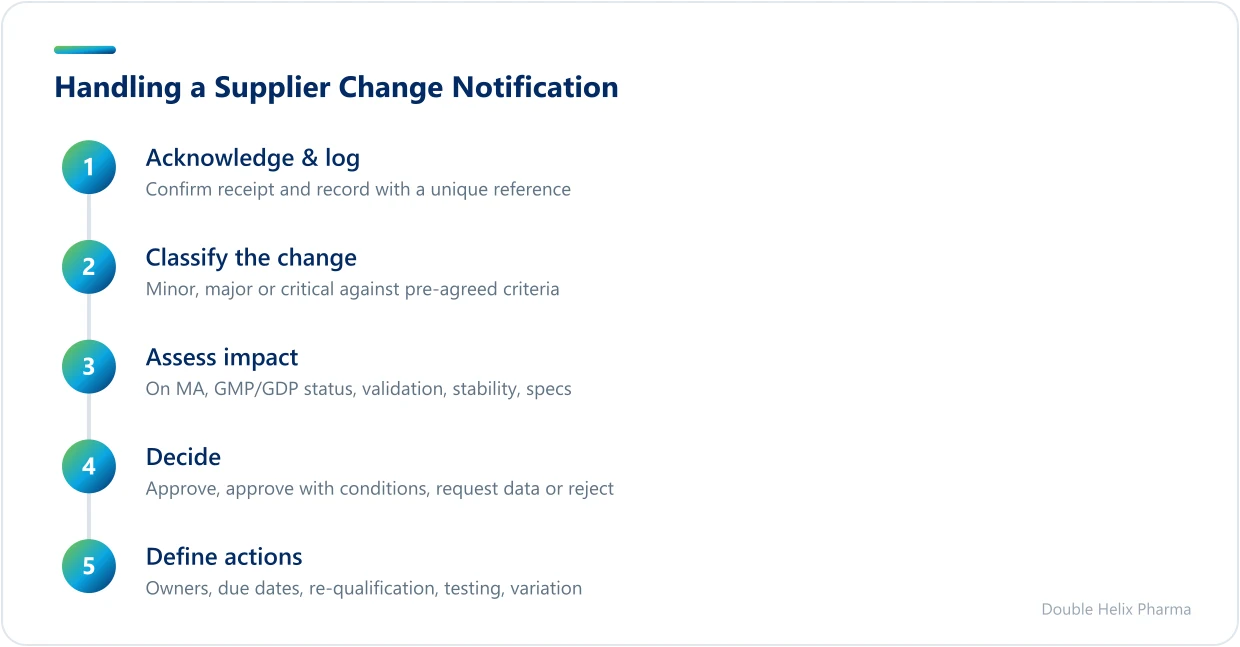
- Acknowledge receipt promptly and log the notification in your change control or supplier file with a unique reference.
- Classify the change as minor, major or critical against pre-agreed criteria, drawing on QP, regulatory affairs and technical input.
- Assess impact on the marketing authorisation, GMP/GDP status, validation state, stability, specifications and any downstream customers of your own.
- Decide: approve, approve with conditions, request more data, or reject and escalate.
- Define actions with owners and due dates, including any need for re-qualification, additional testing, or a variation submission.
Document the rationale at each step. Where a change touches the marketing authorisation, the assessment must consider whether a variation is required before the changed material can be released, and the QP cannot certify affected batches until that position is clear.
Documentation, data integrity and traceability
A supplier change notification process is, at its heart, a documented chain of reasoning. Every entry should satisfy ALCOA+ principles: attributable, legible, contemporaneous, original and accurate, plus complete, consistent, enduring and available. In practice this means the notification, the risk assessment, the approvals and the closing actions must be traceable to named individuals with dates, and retained for the life of the agreement plus the relevant retention period.
Two failure modes recur in inspections. The first is the orphaned notification: an email that was read, perhaps even discussed, but never logged or formally assessed. The second is the open action that quietly ages past its due date with no escalation. Both are visible to an MHRA inspector reviewing your change control register, and both undermine confidence in the wider quality system. A simple, well-maintained log that links each notification to its assessment and closure evidence is one of the most cost-effective controls you can implement. You can see how we have helped organisations tighten this discipline in our case studies.
An unassessed supplier change is not a saved effort; it is an undocumented risk sitting on your shelf.
Common pitfalls and how to avoid them
Even mature quality teams stumble in predictable places. Recognising them in advance is half the battle.
- Retrospective notifications: the supplier informs you after implementation. Treat this as a deviation in its own right and feed it back into supplier performance review.
- Under-classification: a "minor" label applied by the supplier is their opinion, not your decision. Re-classify independently.
- Silent sub-supplier changes: changes deep in the supply chain often never surface unless the agreement explicitly requires onward notification.
- No link to the marketing authorisation: a technically sound change can still create a regulatory non-compliance if a variation is missed.
- Closure without verification: actions marked complete without objective evidence that re-qualification or testing actually occurred.
Building periodic supplier change trending into your management review, alongside deviations and complaints, turns a reactive process into a genuine signal of supplier health and exposes weak performers across your full range of quality and compliance services.
Key takeaways and next steps
Effective supplier change control rests on three foundations: clear expectations set in the quality agreement, disciplined risk-based triage aligned to ICH Q9 and Q10, and traceable documentation that would stand up to MHRA scrutiny. Get those right and supplier change notifications become a managed, predictable part of your quality system rather than a recurring source of surprises. If you would like an independent review of how your team receives, assesses and closes supplier changes, or help drafting agreement clauses that hold up under inspection, get in touch with our team to discuss a practical way forward.
Regulatory sources
This guidance reflects current UK and EU GMP/GDP requirements. Primary references:
- EU GMP Chapter 7 — Outsourced Activities
- EU GMP Part II — Active Substances (APIs)
- EMA — GMP/GDP Questions & Answers
Always confirm against the latest published version of each source.
Frequently asked questions
What is a supplier change notification (SCN)?+
A supplier change notification is a formal communication from a vendor informing you that an aspect of the material or service they supply has changed, or is about to change. This can cover manufacturing sites, processes, raw materials, specifications, analytical methods, packaging or sub-suppliers. Under EU GMP Chapter 7 and the quality agreement, you must assess each notification for impact on product quality, patient safety and regulatory status before the change is accepted.
How quickly should we respond to a supplier change notification?+
Acknowledge receipt promptly and log the notification immediately so it cannot be lost. The overall response time should be proportionate to the risk classification agreed in your quality agreement, with major and critical changes typically requiring written approval before implementation within a defined notice period such as 30 to 90 days. The key inspection expectation is that no major change is implemented without your documented assessment and approval.
What happens if a supplier implements a change without notifying us?+
An unnotified or retrospective change should be handled as a deviation and investigated under your quality system, including an assessment of any batches already received. You should determine the impact on the marketing authorisation, GMP/GDP compliance and product quality, and decide whether affected stock can be released. The event should also feed into supplier performance review and may trigger an audit or escalation depending on severity.