Supplier & Vendor Management · 7 min read
Single vs Dual Sourcing: Managing Supply Risk
A practical UK QP guide to dual sourcing pharma vs single sourcing: use ICH Q9 to weigh supply risk, qualification cost and patient safety.
By Balasubramanian Ramaiah · 9 June 2026 · Updated 13 August 2026
The choice between a single supplier and a dual sourcing pharma strategy sits at the heart of supply-chain resilience and patient safety. It is not simply a procurement decision: it shapes your risk profile, your qualification workload and your ability to keep product on the market when something goes wrong. This article sets out how UK and EU quality teams should weigh the two models and build a defensible, compliant approach to managing supply risk.
Single sourcing: simplicity at a price
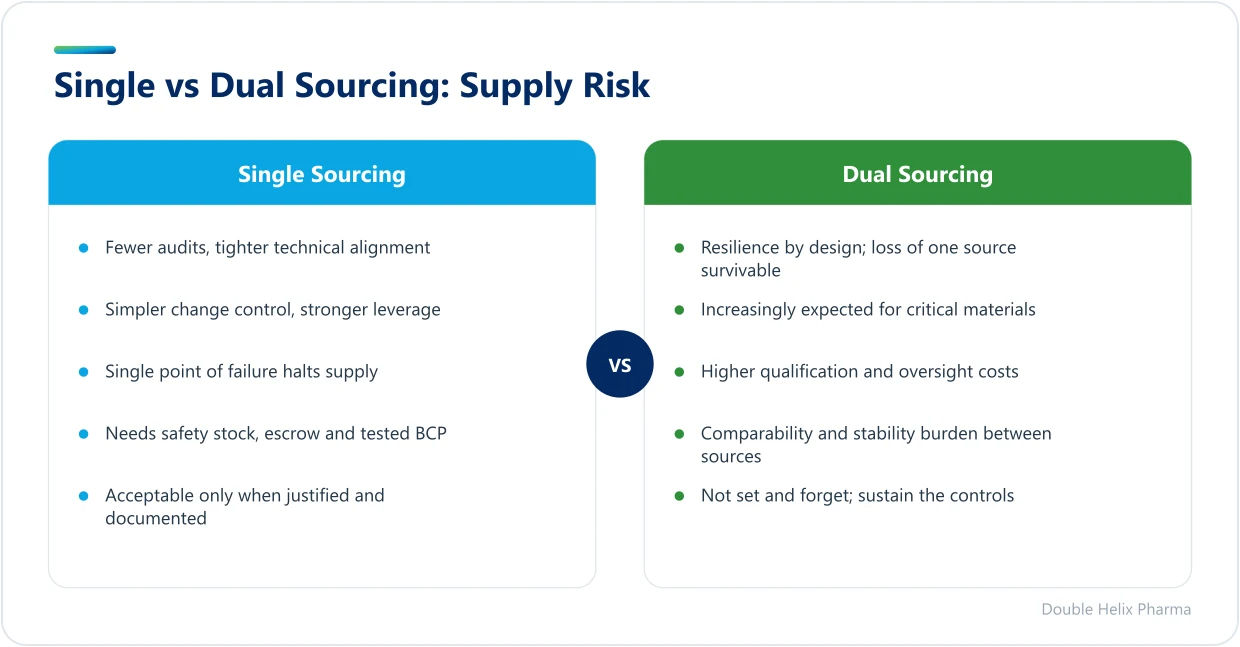
Single sourcing means relying on one approved supplier for a given material, component or service. It is common for specialised excipients, novel APIs, primary packaging with bespoke tooling, and sterile contract manufacturing where qualification is costly and capacity is scarce. The attraction is real: fewer audits, tighter technical alignment, simpler change control and stronger commercial leverage through consolidated volumes.
The exposure is equally real. A single point of failure can halt production through a quality deviation, a regulatory action against the site, a fire or flood, an insolvency, or a geopolitical disruption to logistics. Under EU GMP Chapter 5 and ICH Q10, the manufacturer remains accountable for continuity of supply and for the quality of outsourced activities, regardless of how lean the supplier base is. Where single sourcing is unavoidable, it must be a documented, risk-assessed decision rather than a default born of inertia.
When single sourcing is the right call
- The material is genuinely sole-source (patented, or only one qualified manufacturer exists).
- Qualifying a second source is disproportionate to the residual risk and the product's criticality.
- Robust mitigations exist: validated safety stock, escrow of know-how, and a tested business continuity plan.
Dual sourcing pharma strategy: resilience by design
A dual sourcing pharma strategy qualifies two (or more) suppliers for the same material or activity, so that loss of one does not interrupt supply. This is increasingly expected by regulators and customers for critical materials, and it is a natural extension of the risk-based thinking embedded in ICH Q9. Dual sourcing reduces the probability that a single event becomes a stock-out, and it gives the quality unit negotiating room when a supplier's performance slips.
The trade-offs are higher qualification and oversight costs, greater analytical and stability burden, and the risk of subtle variability between sources. Two suppliers of the same excipient may differ in particle size, residual solvents or microbial profile in ways that affect your product. Dual sourcing is not "set and forget": it multiplies the surfaces you must keep in a validated state.
Qualification considerations for a second source
- Comparability: demonstrate that material from each source performs equivalently, with bridging studies and, where relevant, stability data under ICH conditions.
- Regulatory filings: assess variation requirements with the MHRA and other competent authorities before switching or splitting volumes; an unfiled change is a compliance failure, not a convenience.
- Data integrity: apply ALCOA+ expectations consistently across both suppliers' certificates of analysis and batch records.
- Annex 1: for sterile products, confirm both sources meet contamination-control strategy requirements rather than assuming parity.
Using ICH Q9 to make the decision
Neither model is universally correct. The defensible answer comes from a structured quality risk management exercise under ICH Q9, scoring each material on severity, probability and detectability. Map your bill of materials, then triage: which items are critical to product quality, which are critical to continuity of supply, and which are both? A high-criticality, sole-source API with a single manufacturing line is a very different proposition from a commodity excipient with a dozen interchangeable suppliers.
Risk acceptance is a legitimate outcome — but only when it is justified, documented and signed off by the people accountable for product quality and supply. Silence is not a decision.
Treat the output as a living register. Re-evaluate when a supplier is acquired, relocates a line, receives a regulatory citation, or changes a sub-supplier. A disciplined supplier management programme keeps these assessments current rather than letting them ossify in a forgotten spreadsheet.
Practical mitigations that work in both models
Whether you run single or dual sourcing, the same controls separate resilient operations from fragile ones. None of these is exotic; all of them are routinely missed.
- Risk-based safety stock: size buffers to lead time and re-qualification time, not to a generic rule of thumb. For a sole-source sterile component, that may mean many months of cover.
- Tested business continuity plans: a BCP you have never exercised is a document, not a capability. Run tabletop scenarios with the supplier.
- Quality and supply agreements: define notification obligations for changes, deviations and capacity constraints, with realistic timelines.
- Performance monitoring: track on-time-in-full, complaint and deviation trends, and audit outcomes; escalate adverse signals early.
- Pre-qualified contingency: even where you choose single sourcing, identifying and partially assessing an alternative shortens recovery if the primary fails.
For distributed products, the same logic extends downstream: GDP obligations and the role of the Responsible Person mean that wholesale and import supply chains need contingency too, not just manufacturing inputs.
Governance, ownership and the QP's view
Sourcing strategy is a quality decision dressed as a commercial one. The quality unit, supported by the Qualified Person, must own the risk acceptance and ensure that procurement's drive for efficiency does not quietly erode patient safety. In our experience reviewing client engagements, the most common failure is not choosing the wrong model — it is choosing a model and then failing to maintain the controls that make it safe. Single sourcing without safety stock, or dual sourcing without comparability data, both invite the same outcome: a deviation, a shortage, or an inspection finding.
Embed the decision in your ICH Q10 pharmaceutical quality system. Sourcing risk should appear in management review, in the supplier qualification programme, and in the change-control process, so that a proposed switch triggers the right assessments automatically. Our wider consultancy services are built around exactly this kind of joined-up, inspection-ready governance.
Key takeaways
- There is no universally right answer; a sound dual sourcing pharma decision flows from ICH Q9 risk assessment of each critical material, not from policy or habit.
- Single sourcing can be acceptable when justified, documented and backed by safety stock, escrow and a tested BCP.
- Dual sourcing buys resilience but adds qualification, comparability and oversight obligations you must sustain.
- The quality unit and QP own the risk acceptance; embed it in your ICH Q10 system and keep the register live.
If you are weighing single versus dual sourcing for a critical material, or you want an independent QP review of your supplier risk posture, talk to our team. We can help you build a proportionate, defensible strategy that satisfies the MHRA and keeps product on the market.
Regulatory sources
This guidance reflects current UK and EU GMP/GDP requirements. Primary references:
- EU GMP Chapter 7 — Outsourced Activities
- EU GMP Part II — Active Substances (APIs)
- EMA — GMP/GDP Questions & Answers
Always confirm against the latest published version of each source.
Frequently asked questions
Is dual sourcing a regulatory requirement in the UK or EU?+
There is no blanket rule mandating dual sourcing for every material. However, EU GMP and ICH Q10 hold the manufacturer accountable for continuity of supply and the quality of outsourced activities, and ICH Q9 expects you to manage supply risk proportionately. For critical, sole-source materials, regulators and customers increasingly expect either a qualified second source or robust, documented mitigations.
How much safety stock should we hold for a single-source critical material?+
Size it to the realistic recovery time, not a generic number of weeks. That means the supplier's lead time plus the time to re-qualify or activate an alternative, with a margin for verification and release. For a sole-source sterile component this can run to several months, and the calculation should be documented as part of your business continuity plan.
What is the biggest qualification pitfall when adding a second supplier?+
Assuming the two sources are interchangeable without proving it. Differences in particle size, impurity profile, residual solvents or microbial control can affect your product, so comparability and, where relevant, stability bridging studies are essential. You must also confirm whether the change needs a regulatory variation with the MHRA before splitting or switching volumes.