GMP & GDP Audits · 7 min read
Self-Inspection vs External GMP Audit: What's the Difference?
A practical QP guide to self inspection GMP versus external GMP audits: how they differ in scope, independence and purpose, and how to use both well.
By Balasubramanian Ramaiah · 9 June 2026 · Updated 23 August 2026
Quality teams often treat self inspection GMP activity and external GMP audits as interchangeable, but they answer very different questions and sit in different places in the quality system. A self-inspection asks whether your own operation still meets EU GMP; an external audit asks whether a site you rely on, or one you are accountable for, can be trusted. Understanding where each fits — and where neither is enough — is the difference between a quality system that merely passes inspection and one that genuinely controls risk.
What self-inspection actually means under EU GMP
Self-inspection is a formal regulatory expectation, not an optional housekeeping exercise. EU GMP Chapter 9 requires manufacturers to conduct self-inspections to monitor the implementation and compliance of GMP principles and to propose corrective measures. The defining feature is that the activity is internal: the organisation examines its own premises, systems and behaviours against the standard it is legally bound to meet.
The purpose is honest, structured introspection. A mature self-inspection programme covers the whole quality system over a defined cycle — production, quality control, documentation, premises and equipment, materials management, complaints and recalls, and the effectiveness of previous corrective and preventive actions (CAPA). It is the mechanism through which a site demonstrates the continual improvement and management review expectations of ICH Q10.
Who should carry out a self-inspection
Chapter 9 allows self-inspections to be performed by designated competent persons from within the company, and many sites supplement this with independent specialists. The non-negotiable principle is objectivity: an auditor should not assess work for which they are directly responsible. Inviting a peer from another department, or an external consultant, to challenge a familiar process is one of the most effective ways to break operational blindness.
What an external GMP audit covers and why it differs
An external GMP audit is conducted across an organisational boundary. In practice this takes two main forms: a customer or marketing authorisation holder auditing a supplier, contract manufacturer or laboratory; or a competent authority such as the MHRA inspecting a licensed site. The auditor has no operational stake in the day-to-day running of the site, which is precisely what gives the exercise its weight.
Supplier and contractor audits underpin the qualification and oversight duties set out in EU GMP Chapter 7 and the broader supplier management expectations of Chapter 5. They are how a manufacturer or importer satisfies itself that an outsourced activity is genuinely under control before — and while — it depends on that activity. A regulatory inspection by an authority, by contrast, determines whether a site keeps its manufacturing or wholesale dealer authorisation at all.
The simplest distinction: a self-inspection is the conversation you have with yourself; an external audit is the conversation someone else has about you. Both are essential, and neither substitutes for the other.
Self inspection GMP versus external audit: the practical contrasts
The two activities differ across several dimensions that matter when you design your quality plan.
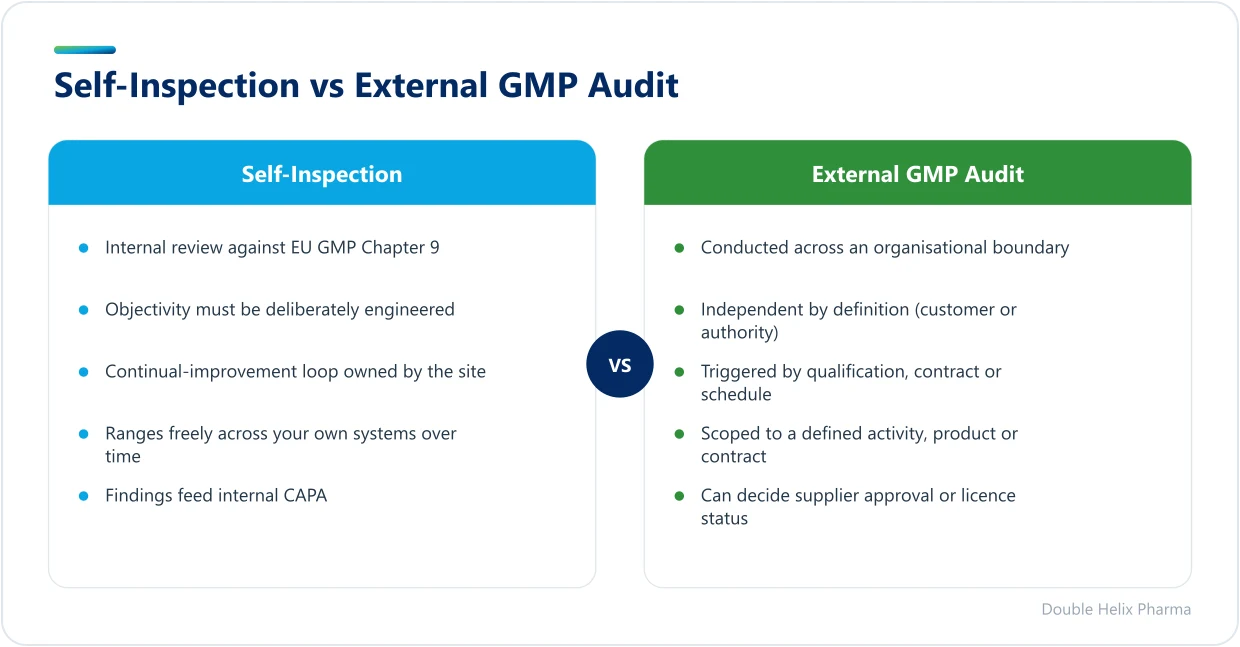
- Independence: self-inspection relies on internal objectivity that must be deliberately engineered; external audits are independent by definition.
- Driver: self-inspection is a continual-improvement loop owned by the site; external audits are typically triggered by qualification, contractual obligation, due diligence or regulatory schedule.
- Scope: self-inspection can range freely across your own systems over time; an external audit is usually scoped to a defined activity, product or contract.
- Consequence: self-inspection findings feed internal CAPA; external audit outcomes can determine approval as a supplier, the terms of a quality agreement, or the status of a licence.
- Candour: a good self-inspection actively hunts for problems before anyone else finds them; an external audit verifies what is presented and tests it against evidence.
There is also a difference in atmosphere. A self-inspection should feel safe enough that staff surface uncomfortable truths — a near-miss data integrity issue, a procedure routinely worked around. An external audit, however collaborative, is ultimately an assessment, and the incentives around it are different.
Where the two activities overlap — and reinforce each other
Although the purposes differ, the disciplines are the same. Both rely on planning, a competent and trained auditor, objective evidence, a clear report, risk-ranked findings and a tracked CAPA process. Both should follow the risk-based thinking of ICH Q9, concentrating effort where patient safety and product quality are most exposed. And both depend on data integrity: ALCOA+ principles — that records are attributable, legible, contemporaneous, original and accurate, and also complete, consistent, enduring and available — apply whether you are reviewing your own batch records or a contractor's.
The strongest quality systems use the two in concert. A rigorous self-inspection programme means external audits and MHRA inspections hold few surprises, because the site has already identified and remediated its weaknesses. Conversely, themes that recur in external audits — of your suppliers, or of your own site — should sharpen the focus of the next self-inspection cycle. Domains such as Annex 1 contamination control for sterile products, or cold-chain controls under GDP, are areas where lessons learned externally should feed directly back into internal scrutiny.
A note on contract and importer arrangements
For organisations operating as contract manufacturers, importers or wholesale dealers, the line blurs usefully. You are simultaneously the subject of others' external audits and the author of your own self-inspections, while also auditing your upstream suppliers. Mapping these obligations clearly — who audits whom, how often, and against what standard — prevents both duplication and dangerous gaps. Our wider view of how these pieces fit together is set out across our consultancy services.
Building a programme that uses both well
Treat self-inspection and external auditing as two halves of a single oversight strategy rather than separate compliance chores. A few principles consistently distinguish effective programmes:
- Schedule deliberately. Define a self-inspection cycle that covers every part of the quality system over a stated period, and align your supplier audit plan to risk rather than convenience.
- Protect independence. Rotate internal auditors, use cross-functional teams, and bring in external eyes where conflicts of interest or specialist knowledge demand it — independent GMP and GDP audit support is particularly valuable for sterile, data-integrity and supply-chain assessments.
- Close the loop. Track every finding to a root-cause-based CAPA, verify effectiveness, and feed trends into management review.
- Learn across the boundary. Let external findings reshape internal scrutiny, and let strong self-inspection make external assessments uneventful.
For a sense of how this works on real sites, our case studies illustrate audit and readiness engagements across manufacturing and distribution settings.
Key takeaways
A robust self inspection GMP programme and a disciplined external audit regime are complementary, not competing. Self-inspection is your structured, candid look in the mirror, mandated by EU GMP Chapter 9 and central to ICH Q10 continual improvement. External audits — whether supplier qualification under Chapter 7 or an MHRA inspection — provide the independent assurance that internal review cannot deliver on its own. Used together, with shared rigour around ICH Q9 risk thinking and ALCOA+ data integrity, they create a quality system that is genuinely inspection-ready rather than merely inspection-tolerant.
If you would like an experienced QP to strengthen your self-inspection programme, prepare for an external audit, or assess a critical supplier, get in touch with our team for a confidential conversation.
Regulatory sources
This guidance reflects current UK and EU GMP/GDP requirements. Primary references:
- EudraLex Volume 4 — EU GMP Guidelines
- EU GMP Chapter 9 — Self Inspection
- MHRA Inspectorate Blog
- EMA — GMP/GDP Questions & Answers
Always confirm against the latest published version of each source.
Frequently asked questions
Is self-inspection a legal requirement under EU GMP?+
Yes. EU GMP Chapter 9 requires manufacturers to conduct self-inspections to monitor compliance with GMP principles and to propose necessary corrective measures. It is a defined regulatory expectation, not optional good practice, and inspectors will review both your self-inspection schedule and the resulting CAPA. It also supports the continual-improvement and management-review expectations of ICH Q10.
Can an external audit replace internal self-inspection?+
No. The two serve different purposes and one cannot substitute for the other. Self-inspection is your own continual, candid review of your quality system, while an external audit provides independent assurance from a customer, authority or third party. A strong self-inspection programme actually makes external audits and MHRA inspections less stressful, because issues are found and fixed internally first.
Who should perform a self-inspection to keep it objective?+
Chapter 9 allows competent designated persons from within the company, but objectivity is essential, so auditors should never assess work they are directly responsible for. Many sites use cross-functional teams, rotate internal auditors, or bring in an independent consultant or contract QP for specialist or higher-risk areas. This independence is what allows a self-inspection to surface problems rather than confirm assumptions.