Supplier & Vendor Management · 7 min read
Quality and Technical Agreements Explained
A quality technical agreement defines GMP and GDP responsibilities between parties. Learn what to include, how to negotiate one, and the pitfalls inspectors find.
By Balasubramanian Ramaiah · 9 June 2026 · Updated 5 September 2026
A quality technical agreement is the document that turns a commercial supply relationship into a controlled, auditable one. It defines who does what across the GMP and GDP lifecycle, removes ambiguity about responsibilities, and gives both parties a shared reference when something goes wrong. For UK and EU pharma, biotech, CMO and importer quality teams, it is one of the most scrutinised documents an inspector will ask to see.
What a quality technical agreement actually is
Often called a Quality Agreement, Technical Agreement or QTA, it is a legally distinct annex to the commercial contract that sets out the GMP and GDP responsibilities of each party. The principle is established in EU GMP Chapter 7 (Outsourced Activities), which requires a written contract between the Contract Giver and the Contract Acceptor that clearly defines roles and prevents misunderstandings that could compromise product quality. The MHRA expects the same discipline for UK-licensed activity, and FDA-regulated supply chains rely on equivalent expectations under 21 CFR 210/211.
Crucially, the agreement separates technical obligations from commercial ones. Price, volumes and penalties belong in the supply contract; batch release, deviation handling, change control and data integrity belong in the quality agreement. Keeping the two apart means your quality terms are not renegotiated every time pricing changes.
Why the quality technical agreement matters under EU GMP and GDP
Outsourcing does not transfer accountability. Under Chapter 7, the Contract Giver retains ultimate responsibility for assessing the competence of the Contract Acceptor and for ensuring the principles of GMP are followed. A robust agreement is how that oversight is evidenced. For distribution, the GDP guidelines apply the same logic: the wholesale dealer remains responsible for activities placed with third parties, including transport, brokering and storage.
Inspectors treat a missing, generic or out-of-date agreement as a red flag because it usually signals weak supplier oversight underneath. The agreement also underpins the Quality Risk Management expectations of ICH Q9 and the lifecycle thinking of ICH Q10 — it is where risk-based controls are made concrete and assigned to a named party.
What to include: the core responsibility matrix
The heart of the document is a clause-by-clause split of duties. A weak agreement lists activities; a strong one names the responsible party for each, with no gaps and no items marked "both" without explanation. As a minimum, address:
- Scope and products — the exact materials, products, sites and activities covered, with manufacturing and importation addresses.
- Batch certification and release — who performs QP certification, against which marketing authorisation, and how release decisions are communicated.
- Deviations, OOS and OOT — notification timelines, investigation ownership, and the obligation to share root cause and CAPA.
- Change control — what must be notified, what requires prior written approval, and how regulatory variations are handled.
- Complaints, recalls and falsified medicines — escalation routes, decision authority and timelines.
- Specifications, sampling and testing — including any reliance on certificates of analysis and the conditions for it.
- Data integrity — explicit commitment to ALCOA+ principles for records generated on either side.
- Audit and right to inspect — the Contract Giver's right of access, and cooperation with regulatory inspections.
- Subcontracting — whether onward outsourcing is permitted and on what conditions.
Storage, transport and contamination control
For GDP scope, set temperature and security controls, qualification of vehicles and lanes, and excursion management. For sterile and high-risk manufacture, align the agreement with the contamination control strategy expected under Annex 1, so responsibilities for environmental monitoring, qualification and trending are unambiguous.
How to write and negotiate a strong agreement
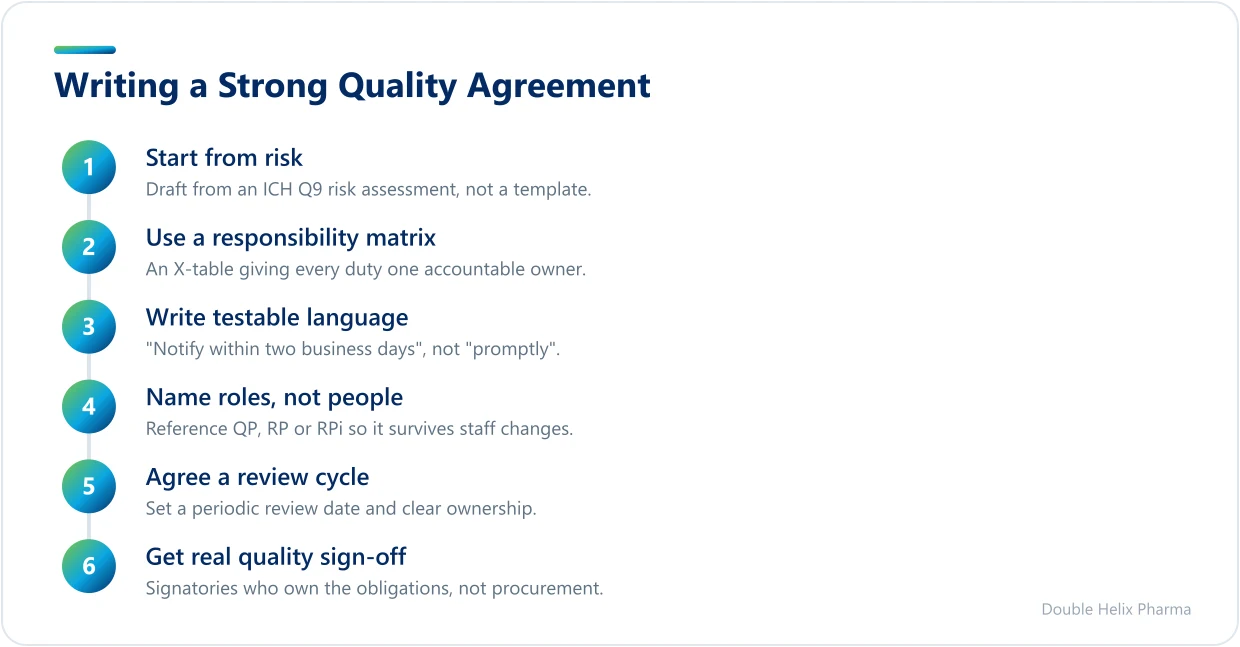
The best agreements are drafted from a risk assessment, not a template. Map the supplied activity, score the risks against ICH Q9, and let that determine the depth of control you write in. A sterile fill-finish CMO warrants far more detail than a supplier of a low-risk excipient.
- Use a responsibility matrix (an "X-table") so every duty has exactly one accountable owner. Reviewers can scan it in minutes and spot gaps.
- Write in plain, testable language. "Notify within two business days" is auditable; "notify promptly" is not.
- Name roles, not individuals. Reference the QP, RP or RPi function so the agreement survives staff changes.
- Agree the review cycle up front. A periodic review date and clear ownership stop the document drifting out of date.
- Get genuine quality sign-off on both sides. The signatories should be the people who own the obligations, not just procurement.
Effective supplier oversight does not stop at signature. The agreement should connect to your wider supplier management programme — qualification, periodic re-assessment and audit scheduling — so the document is a live control rather than a filing-cabinet formality. You can see how this works in practice in our case studies.
Common pitfalls inspectors find
Most agreement findings fall into a handful of recurring patterns. Watch for these in particular:
- Out of date. The activity, site or product has changed but the agreement has not. An unreviewed document several years old invites scrutiny.
- Ambiguous ownership. Duties marked "both" or left blank create exactly the gaps Chapter 7 is meant to close.
- Generic templates. A copy-and-paste agreement that does not reflect the actual process or risk profile of the supplied activity.
- No link to the MA. Release terms that do not tie back to the relevant marketing authorisation.
- Silent on data integrity and subcontracting. Two of the fastest-growing areas of inspector focus.
- Signed by the wrong people. Commercial signatories with no authority over the quality obligations.
Key takeaways
A well-constructed quality technical agreement is not paperwork for its own sake — it is the operational backbone of supplier oversight and a direct demonstration of GMP and GDP compliance. Build it from a risk assessment, give every responsibility a single named owner, keep it aligned to the marketing authorisation, and review it on a defined cycle. Done well, it protects product quality, withstands MHRA and inspectorate scrutiny, and makes the relationship genuinely workable for both parties.
If your agreements are overdue a review, inconsistent across suppliers, or simply inherited without scrutiny, our team can help you build a defensible, audit-ready framework. Contact Double Helix Pharma to discuss your supplier portfolio, or explore the full range of our quality and compliance services.
Regulatory sources
This guidance reflects current UK and EU GMP/GDP requirements. Primary references:
- EU GMP Chapter 7 — Outsourced Activities
- EU GMP Part II — Active Substances (APIs)
- EMA — GMP/GDP Questions & Answers
Always confirm against the latest published version of each source.
Frequently asked questions
What is the difference between a quality agreement and a supply contract?+
A supply contract governs commercial terms such as price, volumes, lead times and penalties. A quality technical agreement is a separate document that defines GMP and GDP responsibilities like batch release, deviation handling, change control and data integrity. Keeping them apart means your quality terms are not reopened every time commercial conditions change, and it satisfies the EU GMP Chapter 7 expectation for a clear written agreement on outsourced activities.
Who should sign a quality technical agreement?+
It should be signed by people with genuine authority over the quality obligations on each side, typically the heads of quality or named QP, RP or RPi functions, rather than procurement alone. Reference roles instead of named individuals so the agreement remains valid through staff changes. Signatories should understand and be able to deliver the responsibilities they are committing to.
How often should a quality technical agreement be reviewed?+
Set a defined periodic review cycle when the agreement is drafted and assign clear ownership for it. Beyond the scheduled review, update the document whenever the supplied activity, site, product or regulatory status changes. Inspectors frequently flag agreements that are years old and no longer reflect the actual process, so a current, accurate document is a strong compliance signal.