GMP & GDP Audits · 7 min read
How to Prepare for an FDA Inspection from the UK
FDA inspection preparation for UK and EU sites: map 21 CFR 211 to EU GMP, ready your site, rehearse the team and respond to a Form 483 with confidence.
By Balasubramanian Ramaiah · 9 June 2026 · Updated 28 August 2026
For a UK or EU site, FDA inspection preparation is a distinct discipline that sits alongside, but not inside, your MHRA and EU GMP routine. The US Food and Drug Administration applies 21 CFR 210/211 and its own enforcement culture, and a single foreign inspection can decide whether your product reaches the American market. This guide sets out how UK manufacturers, importers and CMOs should ready a site, a system and a team for that scrutiny.
Why FDA inspection preparation differs from an MHRA visit
UK quality teams are fluent in EU GMP and MHRA expectations, so the instinct is to treat an FDA visit as another GMP audit. That assumption costs companies dearly. The FDA inspects against its own regulations and uses its own grading: a closing meeting may end with a Form FDA 483 listing observations, and persistent or serious findings can escalate to a Warning Letter or import alert.
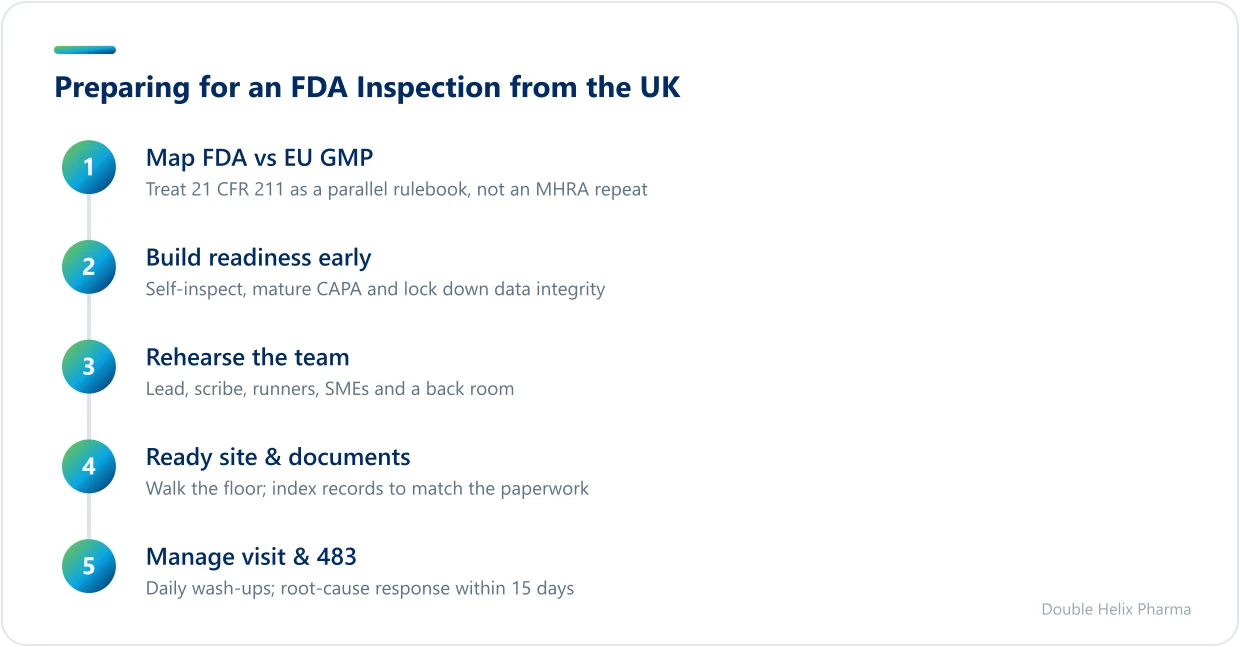
The frameworks overlap in principle but diverge in emphasis. EU GMP and ICH Q10 give you the pharmaceutical quality system; 21 CFR 211 expresses many of the same controls in prescriptive American language. Data integrity expectations are essentially the same idea you already apply under ALCOA+, but FDA investigators probe it relentlessly, especially around audit trails, original records and computerised systems. Treat the US framework as a parallel rulebook to be mapped against your own, not a translation of it.
Pre-Approval versus routine GMP inspections
Be clear on which inspection you face. A Pre-Approval Inspection (PAI) is tied to a specific marketing application and tests whether the data in your submission matches what happens on the floor. A routine GMP surveillance inspection looks at the broader state of control. The preparation overlaps, but a PAI demands that batch records, validation and stability data reconcile exactly with the filing.
Build the inspection readiness foundation early
Readiness is a state, not a sprint in the fortnight before arrival. For foreign sites the FDA typically gives advance notice, but you should assume your quality system must withstand scrutiny on any given day. The work that protects you is done months ahead.
- Self-inspection against 21 CFR 211: run a gap assessment specifically through the US lens, not only your annual EU GMP self-inspection programme.
- CAPA maturity: ensure deviations, complaints and CAPAs are closed on time, with root cause analysis that stands up under ICH Q9 quality risk management thinking.
- Data integrity governance: confirm audit trails are enabled and reviewed, access is role-based, and there are no uncontrolled spreadsheets holding GMP data.
- Document retrieval: you should be able to produce any SOP, batch record, validation report or training record within minutes.
A structured external mock inspection is the single most useful investment, because it surfaces the findings an investigator would raise while you still have time to act. Our GMP audit and inspection readiness service is built around exactly this kind of pressure-testing, and you can see how it plays out in practice in our case studies.
Assemble and rehearse the inspection team
People lose inspections as often as systems do. Decide now who occupies each role and rehearse them until the choreography is second nature.
- Inspection lead / host: a senior quality figure who manages the investigator, the daily agenda and the tone of the engagement.
- Scribe: a dedicated note-taker capturing every question, request and commitment verbatim.
- Runners: staff who retrieve documents quickly from a controlled location.
- Subject matter experts: briefed to answer only what they are asked, factually and without speculation.
- The back room: a separate space that reviews requested documents for completeness and legibility before anything reaches the front room.
Coach the team on conduct. Answer the question that was asked and then stop. Never guess, never volunteer extra documents, and never argue with the investigator. If a question cannot be answered immediately, log it and commit to a clear time to respond. Honest "I will find out" beats a confident but wrong answer every time.
Get the site, documents and quality systems inspection-ready
Walk the site as an FDA investigator would. They will go to the floor, follow a batch, watch operators and ask to see the record behind what they observe. The gemba tells the real story, so the shop floor must match the paperwork.
Documentation and data
Assemble a current, indexed pack: the Site Master File, validation master plan, qualification and validation reports, stability data, the product quality review, the deviation and CAPA log, the complaints log, training matrices and your quality manual. For a PAI, reconcile every figure against the submission. Where computerised systems hold GMP data, be ready to demonstrate audit trail review and CSV under expectations consistent with GAMP and modern data integrity guidance.
Facilities and contamination control
For sterile and aseptic operations, the FDA's expectations align closely with the principles in EU GMP Annex 1: a documented contamination control strategy, sound environmental monitoring data and demonstrable control of your cleanrooms. Inconsistent monitoring trends or an unconvincing rationale for excursions are reliable triggers for observations.
Manage the inspection and the response
Run each day deliberately. Open with a clear presentation of the site, agree the agenda, and hold a daily wash-up with the investigator to surface emerging concerns before they harden into written observations. Where you can correct something on the spot, do so and show the evidence; real-time fixes can keep an issue off the 483 entirely.
If you receive a Form FDA 483, treat the written response as the most important document you will produce that quarter. The FDA looks for a reply, ordinarily within fifteen business days, that addresses each observation with genuine root cause, concrete corrective and preventive actions, realistic timelines and, crucially, an assessment of the wider impact across other products and processes. A defensive or superficial response is what turns a 483 into a Warning Letter.
Key takeaways
Effective FDA inspection preparation from the UK rests on a few disciplines: map 21 CFR 211 against your existing EU GMP and MHRA systems rather than assuming they are interchangeable; keep the site in a permanent state of readiness through self-inspection and mature CAPA; rehearse a disciplined inspection team; and respond to any observation with a credible, root-cause-led plan.
An FDA inspection is won in the months of preparation, not in the room. The investigator simply confirms whether your quality system is real.
If you are facing a Pre-Approval or routine FDA inspection and want an independent, experienced eye before the investigator arrives, explore our full range of consultancy services or contact our QP team to arrange a confidential mock inspection.
Regulatory sources
This guidance reflects current UK and EU GMP/GDP requirements. Primary references:
- EudraLex Volume 4 — EU GMP Guidelines
- EU GMP Chapter 9 — Self Inspection
- MHRA Inspectorate Blog
- EMA — GMP/GDP Questions & Answers
Always confirm against the latest published version of each source.
Frequently asked questions
How much notice does the FDA give a UK site before an inspection?+
For foreign sites the FDA generally provides advance notice, often several weeks, to arrange access and visas, unlike the unannounced inspections common domestically in the US. However, you should never rely on lead time to fix systemic gaps. Treat your quality system as inspection-ready at all times so that notice is used for logistics and rehearsal, not remediation.
Is an FDA inspection the same as an MHRA or EU GMP inspection?+
No. While the underlying GMP principles overlap heavily with EU GMP and ICH Q10, the FDA inspects against 21 CFR 210 and 211 and uses its own enforcement tools, including the Form FDA 483 and Warning Letters. Data integrity and the link between submission data and shop-floor reality are scrutinised especially closely. Map your existing systems against the US framework rather than assuming they are interchangeable.
What should we do if we receive a Form FDA 483?+
Respond in writing, ordinarily within fifteen business days, addressing every observation individually. Each response should give a genuine root cause, specific corrective and preventive actions, realistic completion dates and an assessment of whether the issue affects other products or processes. A thorough, evidence-backed reply is the single best way to prevent a 483 escalating to a Warning Letter.