GMP & GDP Audits · 7 min read
Mock Inspections: How a Dry Run Prevents Real Findings
A mock inspection pharma dry run simulates an MHRA or EU GMP inspection so you catch and fix findings privately, before a regulator ever writes them up.
By Balasubramanian Ramaiah · 9 June 2026 · Updated 20 August 2026
A regulatory inspection is rarely lost on the day the inspector arrives; it is lost in the months beforehand, in the gaps no one rehearsed. A mock inspection in pharma is a structured dry run that simulates an MHRA or EU GMP inspection under realistic conditions, so your team meets pressure, scrutiny and awkward questions before they carry regulatory weight. Done well, it converts the findings that would have appeared on a real deficiency report into internal actions you control on your own timeline.
What a mock inspection pharma exercise actually is
A mock inspection is not an internal audit with a new label. An internal audit typically checks a system against a procedure; a mock inspection tests how your site behaves under inspection conditions, end to end. That means a credible inspector persona, a realistic agenda, document requests issued in real time, facility tours, and live interviews with the people who would actually face the regulator.
The exercise is deliberately adversarial in the constructive sense. The mock inspector follows the threads a real one would: a temperature excursion that leads to an investigation, that leads to a CAPA, that leads to effectiveness checks, that leads to whether anyone verified the fix held. The point is to find where that chain breaks while the only consequence is a private report.
How it differs from self-inspection
- Posture: self-inspection is collaborative; a mock inspection replicates external challenge and time pressure.
- Scope: self-inspection often samples one system; a mock follows risks horizontally across quality, production, QC and the supply chain.
- Output: a mock produces graded observations in inspectorate language, not just a list of non-conformances.
Why dry runs prevent real findings
The value lies in three predictable failure modes. First, the system works but the people cannot evidence it. The data integrity controls exist, but the analyst hesitates when asked to walk through an audit trail review, and hesitation reads as weakness. Second, documentation tells a different story than practice. The procedure says one thing; the floor does another; the inspector notices in ninety seconds. Third, the back room collapses. Requested documents take forty minutes to retrieve, the wrong version surfaces, and confidence drains from the room.
None of these are detected by reading procedures. They surface only when someone sits across the table and asks, then asks again. This is where independent GMP audit and mock inspection support earns its place: an external lead brings the unfamiliarity a real inspector has, free of the assumptions your own staff carry.
The most expensive findings are not the ones you do not understand. They are the ones you understood perfectly and never rehearsed answering.
Building a credible scenario
A mock inspection only works if it feels real. Anchor it to the inspection your site is genuinely likely to face, and let recognised frameworks shape the agenda rather than a generic checklist.
Scope it against real risk
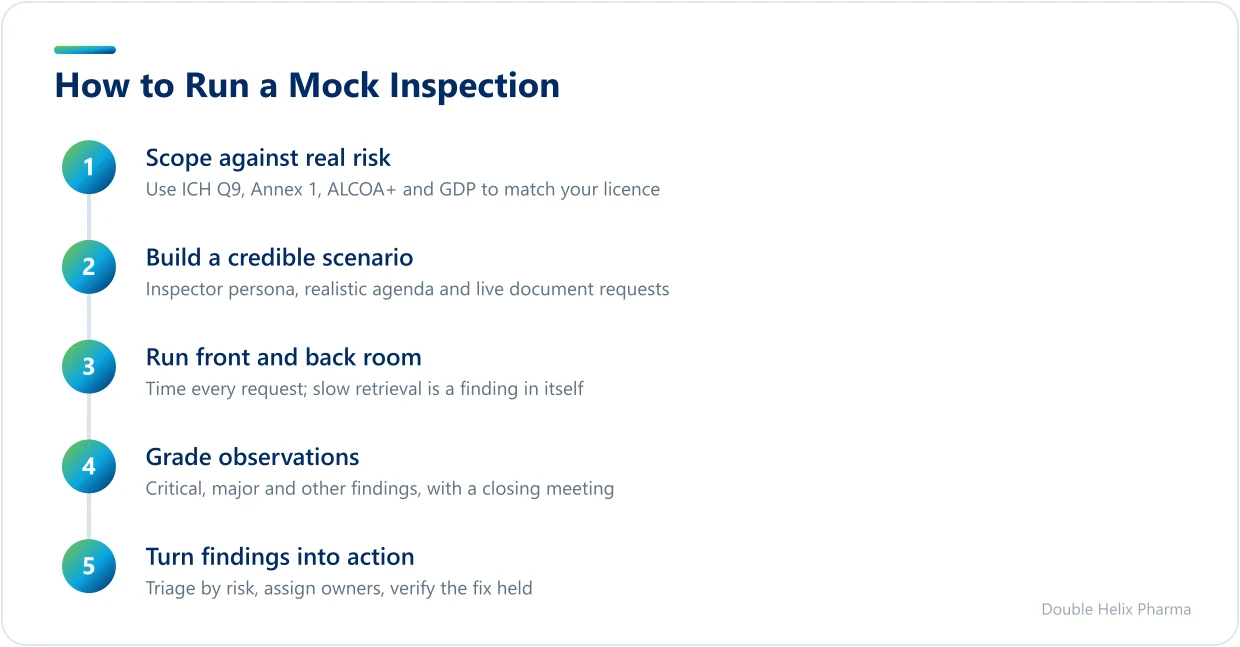
Use ICH Q9 quality risk management to prioritise. A sterile manufacturer should expect deep questioning on contamination control strategy under Annex 1; a wholesale dealer should expect focus on bona fide checks, temperature mapping and falsified medicines controls under GDP guidelines. An importer bringing product in from outside the UK or EU should rehearse QP certification, the supply chain narrative and how batches are released. Map the agenda to your actual licence and activities, not an idealised one.
Test the threads inspectors pull
- Data integrity: probe ALCOA+ in practice, including audit trail review, access controls and how exceptions are handled.
- Quality system maturity: trace a deviation through CAPA and effectiveness review under ICH Q10 to test whether the loop genuinely closes.
- Product quality reviews: ask whether trends actually drive action, or whether the PQR is a document produced once a year and shelved.
- Supplier and outsourced activities: follow a qualification decision and its technical or quality agreement to its evidence.
For sites also subject to FDA oversight, the same disciplines map onto 21 CFR 210 and 211, so a dual-market scenario can rehearse both expectations in one pass without inventing a separate exercise.
Running the day and managing the room
Treat logistics as part of the test. Set up a genuine front room and back room. The front room holds the interviewees and the mock inspector; the back room sources documents, screens them and manages the flow. Time every request. If a record takes too long to appear, that is a finding in itself, and far better discovered now.
Brief participants on conduct as much as content: answer the question asked, not the one you wish had been asked; do not speculate; do not volunteer tangents; and never argue. Many real deficiencies are not failures of the system at all but failures of presentation, where a competent person talks themselves into a problem. A mock inspection lets people make those mistakes safely and learn the discipline of a clean, honest answer.
The mock inspector should grade observations the way an inspectorate would, distinguishing critical, major and other findings, and should hold a closing meeting. Rehearsing the close matters: how your team receives challenge, commits to actions and avoids defensiveness shapes the tone of the real event.
Turning observations into durable readiness
A report that lands and gathers dust is wasted effort. The deliverable should read like a real inspection outcome: graded observations, the evidence behind each, and a risk-based view of what must be fixed before a regulator arrives versus what can follow.
- Triage by risk, not by ease. Use ICH Q9 thinking so the genuinely critical gaps lead, even when they are the hardest to close.
- Assign owners and realistic dates. Vague actions without owners are the findings of the next inspection.
- Verify effectiveness. Under ICH Q10, confirm the fix held rather than assuming the CAPA closure was the end.
- Re-test the weak threads. Where interviews exposed hesitation, run a focused follow-up so the improvement is proven, not hoped for.
Timing matters too. A mock inspection is most valuable several weeks ahead of an expected event, leaving room to act, and as a periodic discipline for sites that want to stay inspection-ready rather than scramble. You can see how this plays out in practice across our case studies, and how it sits alongside our wider quality and compliance services.
Key takeaways
A mock inspection pharma exercise is the cheapest deficiency report you will ever receive, because every observation is one a regulator never gets to write. It exposes the difference between a system that exists on paper and one your people can defend under pressure, and it builds the composure that turns a tense inspection into a controlled conversation.
- Treat it as a realistic simulation, not a relabelled self-inspection.
- Scope it against your real licence and risks using ICH Q9, Annex 1, ALCOA+ and GDP expectations.
- Test the front room and the back room, because retrieval failures are findings too.
- Convert observations into owned, risk-prioritised actions and verify they hold.
If an MHRA or EU GMP inspection is on the horizon, or you simply want to know how your site would really perform, talk to our QP-led team about a tailored mock inspection. We will run the dry run so the real findings never happen.
Regulatory sources
This guidance reflects current UK and EU GMP/GDP requirements. Primary references:
- EudraLex Volume 4 — EU GMP Guidelines
- EU GMP Chapter 9 — Self Inspection
- MHRA Inspectorate Blog
- EMA — GMP/GDP Questions & Answers
Always confirm against the latest published version of each source.
Frequently asked questions
How is a mock inspection different from an internal audit?+
An internal audit usually checks a system against its own procedures in a collaborative setting. A mock inspection replicates the external pressure of a real MHRA or EU GMP inspection, with an inspector persona, live document requests, facility tours and interviews. It tests how your site behaves under scrutiny, not just whether the paperwork exists, and follows risks horizontally across quality, production, QC and the supply chain.
When should we run a mock inspection?+
The greatest value comes a few weeks before an expected inspection, leaving enough time to close any gaps the dry run exposes. It is also wise as a periodic discipline after major change, such as a new product line, a site expansion or a significant remediation. Routine mock inspections keep a site continuously inspection-ready rather than forcing a last-minute scramble.
What frameworks should a mock inspection be based on?+
Anchor the scenario to your actual licence and risks rather than a generic checklist. Sterile sites should expect deep questioning under Annex 1 and contamination control; wholesale dealers should focus on GDP expectations; and data integrity should be probed against ALCOA+. ICH Q9 helps prioritise scope by risk, ICH Q10 tests whether the quality system genuinely closes the loop, and dual-market sites can also rehearse 21 CFR 210 and 211.