GMP & GDP Audits · 7 min read
Writing a GMP Audit Report That Drives Real Change
How to write a GMP audit report that withstands MHRA scrutiny and drives real change: specific findings, risk-based grading, ALCOA+ and closable CAPA.
By Balasubramanian Ramaiah · 9 June 2026 · Updated 3 September 2026
A GMP audit report is not a formality you file and forget. It is the bridge between what an auditor observed on site and what an organisation actually changes as a result. Too many reports describe findings accurately yet fail to move anyone to act, because they read as a list of deviations rather than a case for change. This article sets out how to write a report that holds up to MHRA scrutiny and genuinely drives improvement.
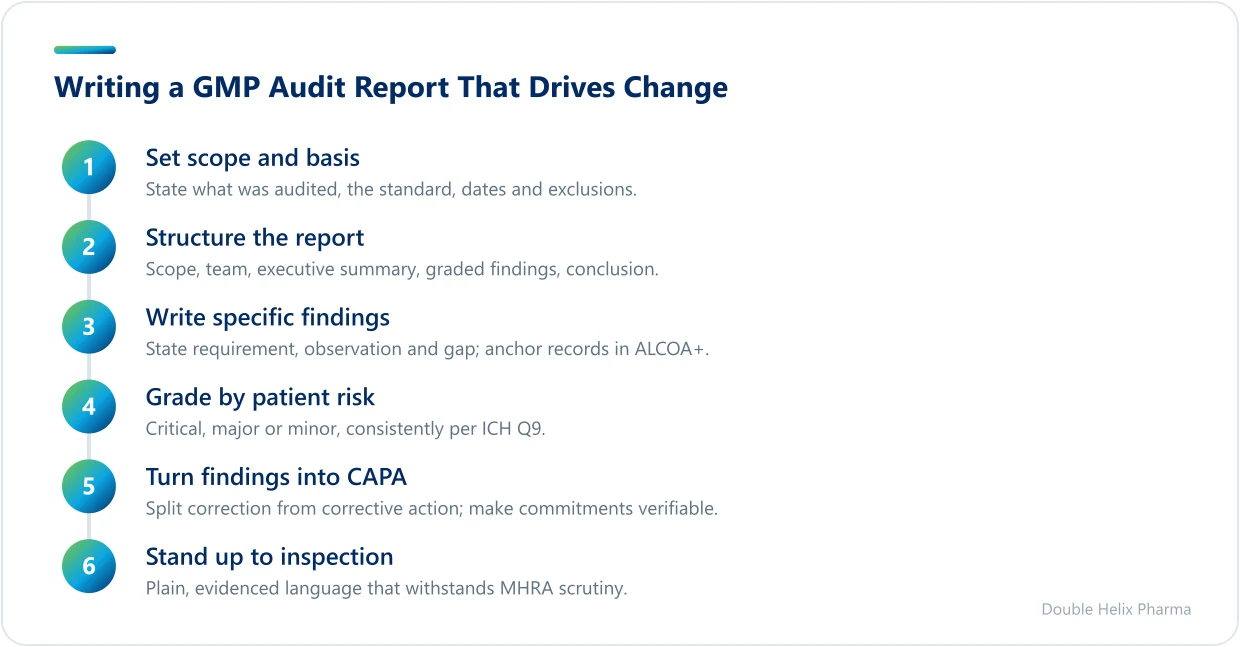
Why most GMP audit reports fail to change anything
The common failure mode is description without consequence. An auditor lists what was seen, cites a clause, and stops. The reader nods, files it, and the same observation recurs at the next audit. A report that drives change does three things the weak report does not: it explains why a finding matters in terms of patient risk and product quality, it makes the required outcome unambiguous, and it gives the recipient enough evidence to defend the action internally when budget or resource is contested.
Under the quality risk management principles of ICH Q9, risk should be proportionate to the threat to the patient. A report that grades a missing signature on a cleaning log the same as a compromised sterile boundary tells the reader nothing useful about where to spend their finite remediation effort. Grading must mean something.
What a GMP audit report must contain
Structure earns trust. A reader who can navigate the document quickly is more likely to act on it. At minimum, a credible report covers:
- Scope and basis. What was audited, against which standard (EU GMP and its annexes, 21 CFR 210/211 where the site supplies the US, or the relevant GDP guidelines), the dates, and the areas or processes excluded.
- Audit team and auditees. Who conducted the audit and who was interviewed, so the evidence trail is attributable.
- Executive summary. A short, honest verdict a quality director can read in two minutes and act on.
- Findings with classification. Each observation graded critical, major or minor, with the rationale for the grade.
- Conclusion and recommendation. A clear statement on the site's acceptability, qualified or otherwise.
Keep the narrative and the findings table consistent. If the summary calls a site broadly compliant but the table lists three critical findings, the report contradicts itself and loses authority.
Grade findings the way you would defend them
A critical finding indicates a significant risk of producing a product harmful to the patient, or a fraud or data integrity concern. A major finding is a significant deviation from GMP that is not critical. A minor finding is a departure that warrants attention but carries limited risk. Apply the grading consistently across the report and across audits, so trends are real rather than artefacts of inconsistent judgement.
Write findings that are specific, evidenced and ALCOA+ aligned
A finding is only actionable if the reader can locate the problem without you in the room. State the requirement, state what was observed, and state the gap. Reference the specific batch record, SOP number, room or piece of equipment. Vague findings produce vague corrective actions.
"Documentation practices were poor" tells the site nothing. "Three of ten reviewed batch records (BR-2291, BR-2304, BR-2310) showed in-process check results recorded retrospectively at end of shift, contrary to SOP-114 and the contemporaneous principle of ALCOA+" tells them exactly what to fix.
Where the finding concerns records, anchor it in ALCOA+ so the data integrity dimension is explicit: is the issue that data is not attributable, not contemporaneous, not original, or not enduring? Naming the attribute affected sharpens the corrective action and signals that you understand the underlying expectation, not just the symptom. For data-rich processes and computerised systems, this framing is often the difference between a quick fix and a meaningful remediation.
Turn findings into CAPA the site can actually close
A report drives change at the point where findings become corrective and preventive actions. Within the ICH Q10 pharmaceutical quality system, CAPA is the formal mechanism for learning from deviations, so the report should make CAPA easy to write rather than leave the site guessing.
- Separate correction from corrective action. Cleaning up the immediate record is a correction. Fixing the system that allowed retrospective entry is the corrective action. Reports that conflate the two let root causes survive.
- Point towards root cause without dictating it. Note patterns across findings that suggest a systemic cause, for example training, supervision or system design, while leaving the formal investigation to the site.
- Make commitments measurable. A response of "staff retrained" is unverifiable. "Revised SOP-114 issued, all operators reassessed, effectiveness check at next quarterly review" can be audited.
This is where many organisations benefit from an experienced second pair of eyes; our GMP audit work focuses as much on whether findings will close meaningfully as on identifying them in the first place.
Tone, evidence and standing up to inspection
Write in plain, factual language. Avoid loaded adjectives and personal blame; the report addresses systems and processes, not individuals. Every claim should be supported by what was seen or by a document reviewed, because an audit report may be requested by an inspector and must withstand that examination. If you would not be comfortable defending a sentence to an MHRA inspector, rewrite it.
Distribute the report promptly while observations are fresh, agree response timelines explicitly, and track actions to closure rather than treating issue of the report as the end of the process. A report that is never followed up trains the organisation to treat audits as theatre. You can see how this end-to-end discipline plays out in our case studies, and how it fits alongside the wider quality support in our services.
Key takeaways
A strong GMP audit report does more than document what went wrong; it makes the case for change so clearly that acting becomes the path of least resistance. Be specific, grade by patient risk, anchor data findings in ALCOA+, and write CAPA that can actually be closed and verified.
- State the requirement, the observation and the gap for every finding.
- Grade consistently against ICH Q9 risk principles and keep the summary and findings aligned.
- Hand the site a clear route from finding to root cause to verifiable CAPA under ICH Q10.
- Write every line so it stands up to MHRA inspection.
If your reports are accurate but your findings keep recurring, the problem is usually in how change is framed rather than in your auditors. Talk to our team about strengthening your audit reporting and CAPA process so that what you observe actually gets fixed.
Regulatory sources
This guidance reflects current UK and EU GMP/GDP requirements. Primary references:
- EudraLex Volume 4 — EU GMP Guidelines
- EU GMP Chapter 9 — Self Inspection
- MHRA Inspectorate Blog
- EMA — GMP/GDP Questions & Answers
Always confirm against the latest published version of each source.
Frequently asked questions
How should findings in a GMP audit report be classified?+
Findings are typically graded as critical, major or minor. A critical finding signals a significant risk of harm to the patient or a data integrity or fraud concern; a major finding is a significant GMP deviation that is not critical; a minor finding warrants attention but carries limited risk. Apply the grading consistently across findings and across audits so that trends reflect real risk rather than inconsistent judgement, in line with ICH Q9 risk principles.
What is the difference between a correction and a corrective action in a CAPA?+
A correction is the immediate fix to the specific problem found, such as completing a missing record. A corrective action addresses the underlying system that allowed the problem to occur, so it cannot recur. Within an ICH Q10 quality system both are needed, but reports that conflate the two tend to leave root causes unresolved and findings recurring at later audits.
How do I make sure a GMP audit report stands up to MHRA inspection?+
Support every statement with what was directly observed or with a specific document reviewed, and reference batch records, SOP numbers, rooms or equipment precisely. Use factual, neutral language that addresses systems rather than individuals, and keep the executive summary consistent with the detailed findings. A practical test is whether you would be comfortable defending each sentence to an inspector; if not, rewrite it.