Supplier & Vendor Management · 7 min read
Qualifying Excipient Suppliers
A UK QP's practical guide to excipient supplier qualification: risk assessment under ICH Q9, qualification dossiers, audits, controls and re-qualification.
By Balasubramanian Ramaiah · 9 June 2026 · Updated 1 August 2026
Excipients are too often treated as the quiet supporting cast of a formulation, yet a single contaminated or substituted excipient can put patients at risk and bring an inspector to your door. Robust excipient supplier qualification is therefore not a procurement formality but a core patient-safety control, sitting squarely within your quality management system. This article sets out how a UK Qualified Person approaches the qualification of excipient suppliers in a way that an MHRA inspector will accept.
Why excipients carry more risk than their cost suggests
Excipients frequently make up the bulk of a finished dosage form, are sourced globally, and are often produced for industries far larger than pharma, such as food, cosmetics and bulk chemicals. That means the manufacturer's primary market may not be operating to pharmaceutical standards, and the material may pass through several brokers and repackagers before it reaches you. The diethylene glycol tragedies, in which an industrial solvent was substituted for pharmaceutical-grade glycerol or propylene glycol, remain the defining lesson: the failure was not in the chemistry but in the supply chain and its oversight.
Under EU GMP Part I, Chapter 5, you are responsible for the quality of the materials you use, regardless of where they originate. The expectation is reinforced by the Falsified Medicines Directive and, for the EU, the formalised excipient risk assessment required under the Commission guidelines of March 2015. In short, you cannot outsource accountability for an excipient simply by buying it from a reputable-looking distributor.
Excipient supplier qualification through formalised risk assessment
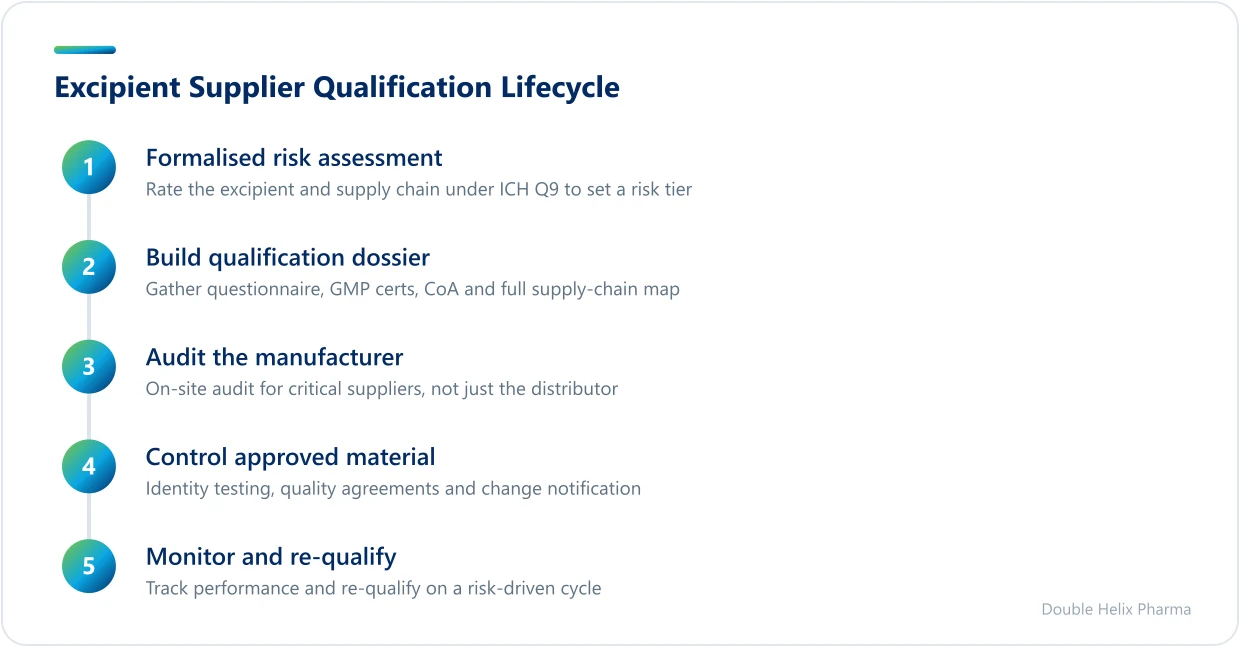
The foundation of any defensible programme is a documented risk assessment that determines the appropriate good manufacturing practice for each excipient and, by extension, how rigorously its supplier must be qualified. This is a direct application of ICH Q9 (Quality Risk Management) and should be repeatable, evidence-based and reviewed periodically.
A proportionate excipient supplier qualification assessment typically weighs two dimensions:
- Risk from the excipient itself: route of administration (parenteral and ophthalmic carry the highest risk), whether it is of animal, mineral, synthetic or fermentation origin, its potential for microbial or elemental contamination, and its function in the product.
- Risk from the supply chain: whether you are dealing with the original manufacturer or an intermediary, the number of handling steps, the country of origin and its regulatory maturity, and the supplier's quality history.
The output is a risk tier that dictates the depth of qualification: a low-risk, single-source excipient for an oral tablet may justify a documented desktop assessment, whereas a high-risk excipient for a sterile product will demand on-site auditing and tighter controls. Our supplier and vendor management service is built around exactly this proportionate, inspector-ready logic.
Building the qualification dossier and evidence base
Once risk is understood, assemble objective evidence rather than assurances. The qualification dossier for an excipient supplier should establish who actually makes the material, to what standard, and how its quality is controlled from manufacture to your goods-in bay.
Core documentation to obtain and review
- A completed supplier quality questionnaire identifying the true manufacturing site, not just the distributor.
- Relevant certifications, such as EXCiPACT or IPEC-aligned GMP, and any compendial compliance (Ph. Eur., USP).
- A representative Certificate of Analysis, checked against the agreed specification and the relevant monograph.
- Safety data, elemental impurity information aligned with ICH Q3D, and TSE/BSE statements where the excipient is of animal origin.
- The full supply-chain map, naming every broker, repackager and storage point between manufacturer and you.
For higher-risk excipients, supplement the paperwork with an audit. A desktop or remote assessment may suffice for lower tiers, but critical suppliers generally warrant an on-site audit of the actual manufacturer. Distributor-only audits are a common weakness; auditing the broker tells you little about how the material was made. For practical audit methodology, see our guidance on running a supplier GMP audit within our broader consultancy services.
Controlling the material once the supplier is approved
Approval is the beginning of control, not the end of it. The qualification decision must be formally recorded, the supplier added to your approved supplier list, and the basis for approval retained as part of your ICH Q10 pharmaceutical quality system. Crucially, the controls you place on incoming material should match the residual risk you identified.
Ongoing controls that inspectors expect to see
- Defined acceptance testing: identity testing on every container is the baseline expectation for excipients; reduced testing must be justified and supplier-qualification-dependent.
- Technical or quality agreements: clear, signed agreements defining specifications, change notification obligations and responsibilities, consistent with Chapter 7 on outsourced activities.
- Change notification: a binding commitment from the supplier to notify you of any change to source, process or specification before implementation.
- Data integrity: Certificates of Analysis and supporting records assessed against ALCOA+ principles, with attention to whether data is attributable, contemporaneous and original.
An approved supplier list is only as credible as the evidence and the monitoring behind each entry. Status on paper is not the same as control in practice.
Keeping qualification live: monitoring and re-qualification
Excipient supplier qualification is a continuing obligation, not a one-off gate. Performance should be monitored through goods-in results, deviations, complaints and out-of-specification trends, and fed into periodic management review. Any significant signal, such as a change of manufacturing site, a serious quality defect, a recurring impurity or an adverse inspection finding, should trigger reassessment outside the routine cycle.
Re-qualification frequency should be driven by the risk tier rather than a single fixed interval: critical excipient suppliers reviewed more often than low-risk ones, with the rationale documented. The objective is simple but demanding: approval status should always reflect the supplier's current, real-world performance. Examples of how this works in practice are set out in our case studies.
Key takeaways
Effective excipient supplier qualification rests on a few non-negotiable principles: treat excipients as genuine sources of risk, drive the depth of assessment from a documented ICH Q9 risk evaluation, qualify the real manufacturer rather than the distributor, and keep the qualification live through monitoring and proportionate re-qualification. Get these right and your supply chain becomes an asset you can defend, not a liability you hope is never tested.
If you are building, strengthening or defending an excipient qualification programme, our team of UK Qualified Persons can help you make it both proportionate and inspection-ready. Get in touch to discuss your supply chain and quality requirements.
Regulatory sources
This guidance reflects current UK and EU GMP/GDP requirements. Primary references:
- EU GMP Part II — Active Substances (APIs)
- EU GMP Chapter 7 — Outsourced Activities
- EMA — GMP/GDP Questions & Answers
Always confirm against the latest published version of each source.
Frequently asked questions
What is excipient supplier qualification and why does it matter?+
Excipient supplier qualification is the risk-based process of confirming that a supplier can consistently provide an excipient that is fit for pharmaceutical use, including assessing the true manufacturer, documentation and, where needed, on-site audits. It matters because excipients often form the bulk of a dosage form yet are frequently made for non-pharmaceutical markets and pass through multiple intermediaries. A weak qualification programme is a recognised root cause of contamination and substitution incidents.
Do I need to audit the excipient manufacturer or is the distributor enough?+
For higher-risk excipients you should qualify and, where appropriate, audit the actual manufacturer rather than relying on the distributor. Auditing only a broker tells you little about how the material was produced or controlled. For lower-risk excipients, a documented desktop or remote assessment may be sufficient, provided the risk rationale is recorded in line with ICH Q9.
How is the level of excipient supplier qualification decided?+
The depth of qualification is determined by a formalised risk assessment that weighs the excipient itself, such as route of administration and origin, against supply-chain factors like the number of handling steps and country of origin. This follows the ICH Q9 principle that effort should be proportionate to risk. The resulting risk tier dictates whether a desktop review, remote assessment or full on-site audit is required, and how tightly incoming material is then controlled.