GMP & GDP Audits · 8 min read
What Auditors Look For in Your Cleaning Validation
What inspectors expect in a cleaning validation audit: worst-case rationale, health-based limits, recovery studies, data integrity and ongoing verification.
By Balasubramanian Ramaiah · 9 June 2026 · Updated 30 August 2026
Of all the systems a regulator probes, few expose the maturity of a quality operation as quickly as cleaning. A cleaning validation audit tests whether you can prove — with data, not assurances — that residues of the previous product, cleaning agents and bioburden are reduced to scientifically justified, safe limits before the next batch begins. Inspectors are not looking for a thick binder; they are looking for a defensible chain of reasoning from worst-case selection through to ongoing verification, and they will pull the thread until it either holds or breaks.
Why cleaning validation attracts scrutiny
Cross-contamination is a direct patient-safety risk, which is why EU GMP treats cleaning as a critical control rather than a housekeeping task. Chapter 3 and Chapter 5 set the expectation that shared facilities and equipment are controlled to prevent carry-over, and Annex 15 (Qualification and Validation) gives the explicit requirement to validate cleaning procedures. For sites supplying or importing into the US market, the same logic underpins 21 CFR 211.67. The common thread is that cleaning is a process to be validated and kept in a state of control, not a one-off study to be filed and forgotten.
An auditor's interest is proportional to risk. Multi-product facilities, highly potent or sensitising compounds, biologics and sterile manufacture all raise the stakes, and Annex 1 reinforces that contamination control must be addressed holistically through a documented Contamination Control Strategy. The more product your equipment shares, the harder your cleaning evidence has to work.
What auditors look for in your cleaning validation programme
A focused cleaning validation audit tends to follow a predictable arc: the strategy, the science behind the limits, the analytical evidence, and proof that control is sustained. Expect questions in each of the following areas.
Worst-case rationale and product grouping
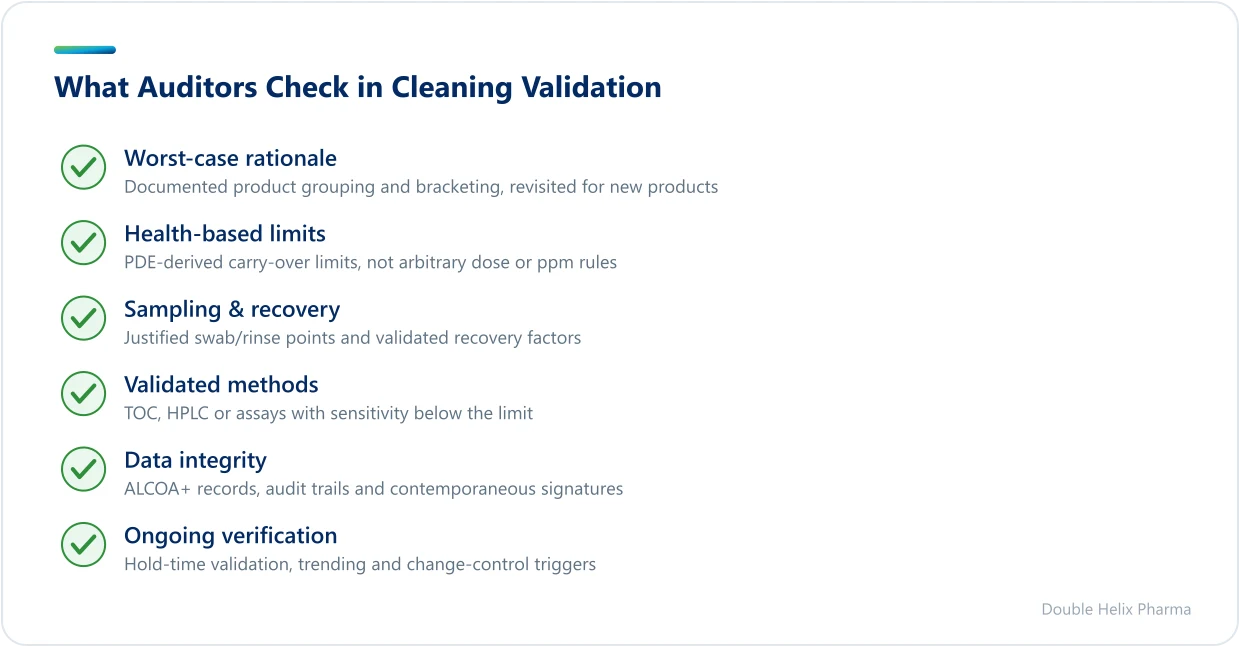
Validating every product–equipment combination is rarely practical, so most sites use a bracketing or worst-case approach. Inspectors will challenge how you chose the worst case: solubility, toxicity, therapeutic dose, batch size, equipment train and difficulty of cleaning should all feed the decision. The grouping must be documented, justified and revisited whenever a new product is introduced — an orphaned product that never made it into the matrix is a classic finding.
Acceptance limits built on health-based exposure
The era of arbitrary "1/1000th of a dose" or "10 ppm" limits as a sole justification has passed. The EMA guideline on setting health-based exposure limits expects a Permitted Daily Exposure (PDE), derived by a qualified toxicologist, to drive carry-over calculations. Auditors will ask to see the PDE rationale, the maximum allowable carry-over calculation, the surface-area data behind it and confirmation that the resulting limit is actually achievable and analytically detectable. Vague or undocumented limits invite immediate follow-up.
Sampling, recovery and analytical method validation
Limits are only as credible as the methods that measure against them. Expect detailed questions on swab versus rinse sampling, the justification for sampling locations (including hard-to-clean and hard-to-reach points), and — critically — recovery studies. A swab recovery factor that has never been determined, or one applied without justification, undermines every result that depends on it. Analytical methods, whether TOC, HPLC or specific assays, must be validated for the intended purpose, with sensitivity demonstrably below the acceptance limit.
Visual inspection and the "visually clean" trap
"Visually clean" remains a legitimate criterion, but only when supported. Auditors look for an established visible-residue limit, defined viewing conditions, and operators trained and qualified to make the judgement. Relying on visual inspection alone, without a quantitative limit beneath it, is a frequent weakness — particularly for potent compounds where the safe limit sits well below what the eye can detect.
The documentation and data integrity an auditor will test
Cleaning validation generates exactly the kind of records where data integrity weaknesses surface. ALCOA+ applies in full: results must be attributable, legible, contemporaneous, original and accurate, as well as complete, consistent, enduring and available. In practice an auditor will cross-check the validation protocol and report against raw analytical data, equipment logs and batch records, looking for alignment.
- Protocol and report integrity: pre-defined acceptance criteria, no post-hoc adjustment of limits to fit results, and deviations handled through the formal system.
- Contemporaneous records: cleaning performed and recorded in real time, with legible signatures and accurate dates and times rather than retrospective completion.
- Equipment status and hold times: validated clean-hold and dirty-hold times, with clear status labelling so equipment cannot be used outside its validated window.
- Audit trails: for TOC, HPLC and other instruments, audit trails enabled, reviewed and reconciled with reported results.
The fastest way to lose an inspector's confidence is a report whose conclusion the underlying data cannot support. The fastest way to keep it is a clear line of evidence from worst-case rationale to verified result.
From validation to verification: proving ongoing control
Annex 15 reflects a lifecycle view, and auditors increasingly expect the same. Three validation runs are a starting point, not an endpoint. Mature programmes move towards ongoing cleaning verification and periodic review, with monitoring data demonstrating that the process remains in control between formal revalidations. This sits comfortably within the continual-improvement expectations of ICH Q10 and the risk-based thinking of ICH Q9.
Inspectors will probe your change-control and revalidation triggers: a new product, a change of cleaning agent, modified equipment or a shift in campaign length should all prompt assessment. Trending of cleaning results, manual versus automated cleaning, and operator-to-operator variability for manual processes are common areas of questioning. Where recurring deviations or adverse trends appear, the auditor will want to see root-cause analysis and effective CAPA rather than repeated re-cleaning. Patterns we see across client sites are reflected in our audit case studies, where ongoing verification frequently distinguishes a robust programme from a fragile one.
Common findings worth pre-empting
- Acceptance limits not underpinned by a toxicologically derived PDE.
- Recovery factors missing, outdated, or not applied to results.
- Worst-case matrix not updated when new products were introduced.
- Clean-hold and dirty-hold times asserted but never validated.
- Over-reliance on "visually clean" with no quantitative limit beneath it.
Each of these is straightforward to remediate before an inspection and costly to explain during one. A structured gap assessment against Annex 15 and the EMA exposure-limit guidance, delivered through independent GMP and GDP audit support, is usually the quickest route to confidence. The same disciplines extend across the wider quality system covered by our consultancy services.
Key takeaways
A successful cleaning validation audit rests on a single principle: every limit, method and conclusion must be traceable to documented science and verifiable data. Build acceptance criteria on health-based exposure limits, validate your sampling and recovery, keep your worst-case matrix current, and treat ongoing verification as part of the lifecycle rather than an afterthought. Above all, ensure the report's conclusions are something your raw data can withstand under questioning.
If you would like an experienced QP to pressure-test your cleaning validation before a regulator does, our team runs independent mock audits and gap assessments tailored to your facility and product risk. Get in touch with Double Helix Pharma to arrange a confidential discussion.
Regulatory sources
This guidance reflects current UK and EU GMP/GDP requirements. Primary references:
- EU GMP Annex 15 — Qualification and Validation
- EudraLex Volume 4 — EU GMP Guidelines
- EU GMP Chapter 9 — Self Inspection
- MHRA Inspectorate Blog
Always confirm against the latest published version of each source.
Frequently asked questions
How many runs are needed to validate a cleaning process?+
Three consecutive successful runs has long been the conventional baseline for demonstrating reproducibility, and it remains a reasonable starting point under Annex 15. However, the current expectation is lifecycle-based: the number of runs should be justified by risk, and validation should be followed by ongoing verification rather than treated as a one-off event. Auditors increasingly expect monitoring data that shows the process stays in control between formal revalidations.
How should cleaning acceptance limits be set?+
Limits should be derived from a health-based Permitted Daily Exposure (PDE) established by a qualified toxicologist, in line with the EMA guideline on setting health-based exposure limits. The PDE drives the maximum allowable carry-over calculation, which is combined with shared surface area to give a practical, analytically detectable limit. Older approaches such as 1/1000th of a dose or 10 ppm are no longer acceptable as a sole justification.
Why are recovery studies so important in a cleaning validation audit?+
A recovery study establishes how much residue your sampling method actually captures from a surface, expressed as a recovery factor that corrects your reported results. Without a justified recovery factor, swab and rinse results cannot be relied upon, so every downstream conclusion becomes questionable. Auditors routinely ask to see recovery data, and missing or unjustified recovery factors are a common and avoidable finding.