QMS & PQS Implementation · 7 min read
Deviation Management Done Right
Practical, inspection-ready deviation management for UK and EU pharma teams: risk-based triage, robust root cause, defensible impact assessment and CAPA.
By Balasubramanian Ramaiah · 9 June 2026 · Updated 25 August 2026
Done well, deviation management is one of the clearest signals of a mature pharmaceutical quality system; done badly, it is the single fastest route to an MHRA finding and a stalled batch release. This article sets out how UK and EU quality teams can build a deviation process that withstands inspection, protects product, and actually drives improvement rather than generating paperwork. The principles apply equally to manufacturers, importers, CMOs and licensed wholesale dealers operating under EU GMP and GDP.
Why deviation management is a regulatory keystone
Under EU GMP Chapter 1, the Pharmaceutical Quality System must ensure that deviations are recorded, investigated and assessed for their impact on product quality. The expectation is reinforced across ICH Q10, which frames deviation handling as part of the corrective and preventive action (CAPA) system and the wider management of process performance. For importers and wholesale dealers, the GDP guidelines (2013/C 343/01) carry an equivalent requirement to manage and document departures from established procedures.
Inspectors rarely take issue with the fact that a deviation occurred. Manufacturing is variable and biology is messy. What attracts findings is a weak investigation, an unsupported impact assessment, a missing root cause, or a CAPA that never closes. A deviation record is, in effect, a small piece of evidence that your quality system can think. Treat it that way.
Build a risk-based deviation process
The foundation is a single, well-written SOP that defines what a deviation is, how it is triaged, and who owns each step. The most common structural failure is the absence of a clear classification step at the point of capture.
Classify by impact, not by convenience
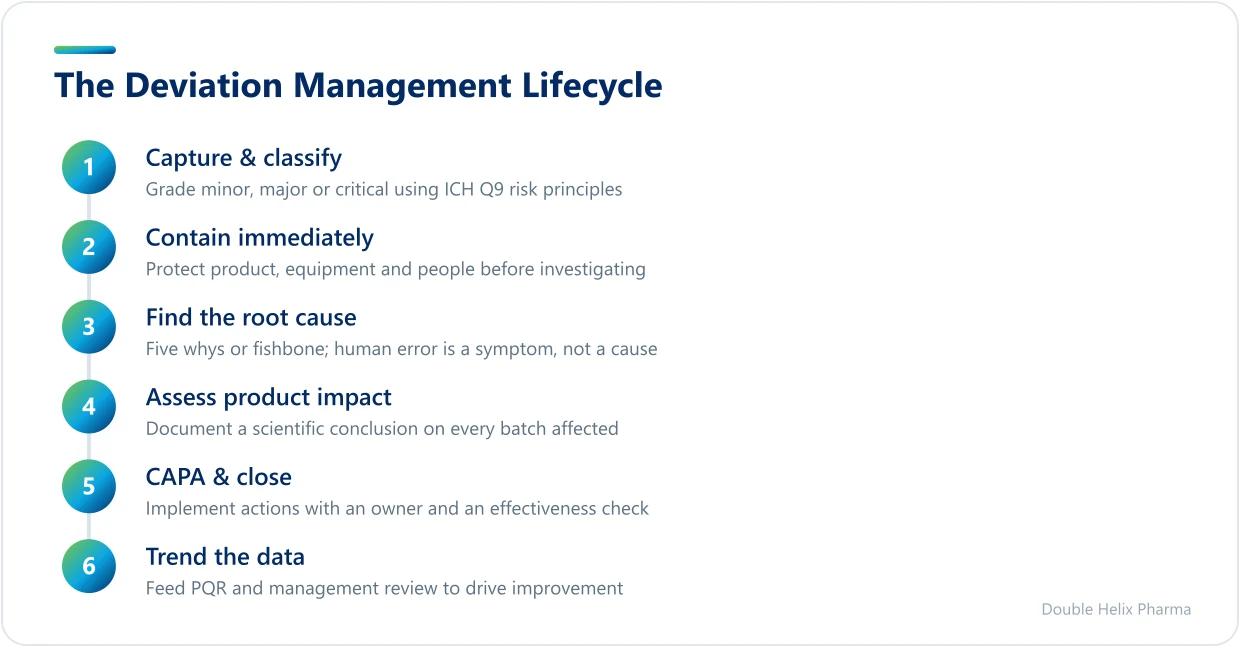
Apply ICH Q9 principles to grade each event — typically minor, major or critical — based on its potential impact on product quality, patient safety and data integrity. The classification should drive the depth of investigation and the seniority of approval, not the other way round. A critical deviation touching a sterile product under Annex 1 demands a different response from a minor documentation error, and your SOP must make that proportionality explicit.
Separate the immediate action from the investigation
Two questions must be answered quickly and independently. First, what do we do now to contain the event and protect product, equipment and people? Second, what was the root cause, and what will stop it recurring? Conflating containment with root cause is how teams end up closing records with "operator retrained" and nothing else.
Investigate the root cause properly
This is where most deviation systems quietly fail. A structured technique — the five whys for simpler events, or a fishbone or fault-tree analysis for complex multi-factor cases — forces the investigation past the first plausible explanation. Human error is a symptom, not a root cause; if your conclusion is that someone made a mistake, the real question is why the system allowed that mistake to reach product.
- Define the problem precisely — what happened, where, when, on which batch or product, and the measured extent of the deviation.
- Gather objective evidence — batch records, equipment logs, environmental data, training records and interviews, captured in line with ALCOA+ so the investigation itself is attributable, legible, contemporaneous, original and accurate.
- Test the hypotheses — distinguish the most probable root cause from contributing factors, and document why alternatives were discounted.
- Assess product impact — reach a documented, scientifically justified conclusion on every batch potentially affected, including product already released or distributed.
The impact assessment is the part the Qualified Person will scrutinise most closely at certification. It must be defensible on its own terms, not a summary that assumes the conclusion.
From CAPA to closure and trending
A deviation is not closed when the investigation is written; it is closed when the corrective and preventive actions are implemented and shown to be effective. Distinguish clearly between correction (fixing the immediate problem), corrective action (preventing recurrence of this cause) and preventive action (addressing the same risk elsewhere on site). Each action needs an owner, a due date and a defined effectiveness check.
A CAPA without an effectiveness check is a promise, not a control. Inspectors read the difference instantly.
Equally important is what happens to the data afterwards. Individual deviations tell you about single events; trended deviation data tells you about the health of your processes. Periodic review — feeding into the Product Quality Review and into management review under ICH Q10 — turns a backlog of records into genuine intelligence about recurring failure modes, supplier issues and systemic weaknesses. We explore how this connects to wider system design in our work on QMS implementation, and you can see practical outcomes in our case studies.
Common pitfalls that generate findings
- Overdue investigations — set realistic timeframes by classification and escalate breaches; a perennial backlog is itself a finding.
- Generic root causes — "human error" or "procedure not followed" without further analysis.
- Weak impact assessments — conclusions that are asserted rather than justified against data.
- CAPA that never closes — open actions years past their due date, with no effectiveness evidence.
- Disconnected systems — deviations, change control and CAPA managed in silos, so the same problem recurs through a different door.
Key takeaways
Strong deviation management is risk-based, evidence-led and connected to the wider quality system. Classify proportionately using ICH Q9, separate containment from investigation, find the real root cause rather than blaming the operator, and prove your CAPA actually works before you close. Above all, trend the data so deviations inform continual improvement instead of accumulating as liability.
If your deviation backlog is growing, your investigations are being challenged at inspection, or you simply want an experienced QP to pressure-test your process, get in touch with our team to discuss a focused review. You can also explore the full range of our consultancy services across GMP and GDP.
Regulatory sources
This guidance reflects current UK and EU GMP/GDP requirements. Primary references:
- EU GMP Chapter 1 — Pharmaceutical Quality System
- EudraLex Volume 4 — EU GMP Guidelines
- EMA — GMP/GDP Questions & Answers
Always confirm against the latest published version of each source.
Frequently asked questions
What is the difference between a deviation and a CAPA?+
A deviation is a departure from an approved procedure, specification or standard that has already occurred and must be recorded and investigated. A CAPA (corrective and preventive action) is the set of actions arising from that investigation: the corrective action prevents recurrence of the specific cause, while the preventive action addresses the same risk elsewhere. One deviation may generate several CAPAs, and the deviation is only truly closed once those actions are implemented and shown to be effective.
How quickly must a pharmaceutical deviation be investigated?+
There is no single regulatory number; instead, EU GMP and ICH Q9 expect timeframes proportionate to the risk and clearly defined in your SOP. A common approach is shorter targets for critical and major deviations and slightly longer ones for minor events, with documented justification for any extension. What inspectors look for is that you meet your own stated timeframes and escalate breaches, rather than allowing an open-ended backlog to build.
Why is 'human error' not an acceptable root cause?+
Human error describes what happened, not why it was able to affect product, so it rarely supports an effective corrective action. A robust investigation asks why the system permitted the error to occur and reach the product, often uncovering issues with procedure design, training, workload, equipment or supervision. Closing a record with 'operator retrained' alone is a frequent inspection finding because it leaves the underlying systemic weakness untouched.